
Evaluate Candidates Who Turn Knowledge Into Action with the Ability to Apply Trait
Two people can describe the same plan with equal conviction, and only one of them ever carries it out. The ability to apply trait measures that gap directly, scoring how much willingness and energy a person puts into doing work rather than thinking about ideas.

What Does the Ability to Apply Trait Measure?
The ability to apply trait measures the willingness and energy one has to do things and work rather than think about ideas. In practical terms, it reflects how physically busy a person is and how much time they spend at work, which makes it the measurement of lazy or hard working.
However, it does not measure the skill in applying techniques, so a high score says nothing about whether the effort is aimed well.
Why ability to apply problems are invisible in interviews
Interviews reward talking about work, and talking about work is exactly what a low scorer does best. Someone likely to be a procrastinator on anything but thinking will still walk you through past projects fluently, because the describing is the part they enjoy. Scored across many items instead, the distance between intending to act and actually acting becomes measurable.
What the Ability to Apply trait helps you evaluate before you hire

Extreme low scores on this trait are automatically included in lowering the Motivation trait, so the two readings move together and belong in the same conversation. Clients have mentioned that their employees who scored in the low range sometimes turned out to be lazy.
Why the Ability to Apply Trait Matters in Hiring
This trait is unusual in that the ideal reading sits in the middle rather than at the top — too little effort leaves the work undone, and too much of it can mean time thrown at problems instead of solving them.

Lazy or Hard Working
This is the measurement of lazy or hard working, stated plainly. Few scores answer so directly the question most hiring managers are already asking themselves about a candidate.

Effort Is Not Output
High scorers stay visibly busy. They may also throw time and effort at problems rather than effectively dealing with them, which reads as commitment while it quietly costs results.

A Thinker Can Still Fit
A low reading is not a rejection by itself. Candidates in this range may do well on purely thinking type jobs, so weigh the score against what the position genuinely requires.

How low Ability to Apply scores show up on the job
Low readings rarely announce themselves in the first week. Instead the pattern builds over months, as work agreed in a meeting quietly fails to arrive.
Learn more about our Assessments
"*" indicates required fields
How the Ability to Apply Trait Is Scored
Five ranges describe this trait, and the ideal band sits narrower than most. Specifically, the range between 40 and 55 is the ideal range for the ability to apply, while any reading under 40 is the documented trigger for structured interview questions about work ethic.
Scores at the very top deserve caution too, since they make up only a tiny part of the overall competency prediction.

Any reading under 40 is the documented trigger for structured work-ethic questions, and 40 to 55 is the ideal range.
Extreme Low — 0 to 12
Likely to be a procrastinator on anything but thinking. Scores here automatically lower the Motivation trait and should be closely interviewed before hiring.
Low — 13 to 39
May have difficulty getting things done and applying what he or she has been taught. May do well on purely thinking type jobs such as a chip designer.
Medium — 40 to 70
Shows good balance between thinking and producing. The range between 40 and 55 is the ideal range for the ability to apply.
High — 71 to 95
Likely to be good at doing and being busy. May throw time and effort at problems rather than effectively dealing with them.
Extreme High — 96 to 100
Likely to be a workaholic. Suits jobs requiring a lot of effort without a lot of thought, and adds only a tiny part to the competency prediction.
Ability to Apply is one of three traits measured together in General Competency
No single score on this assessment stands alone, and this one shifts meaning considerably depending on the readings beside it.

Motivation
Motivation covers the energy and interest to get things done. Extreme low readings on this trait automatically lower that score, so review them as a pair.

Focus
Focus covers priorities and listening. People who cannot focus may look busy without producing results, and that weakness may also appear alongside an extremely high score.

Concentration
Concentration measures sustained mental control on a single subject. These two were first identified as affecting competency, and a busy candidate with low concentration scatters effort.

Analytical Intelligence
Analytical Intelligence scores logical problem solving through the word test. A low reading beside strong analytical results points toward purely thinking type positions rather than rejection.
General Competency
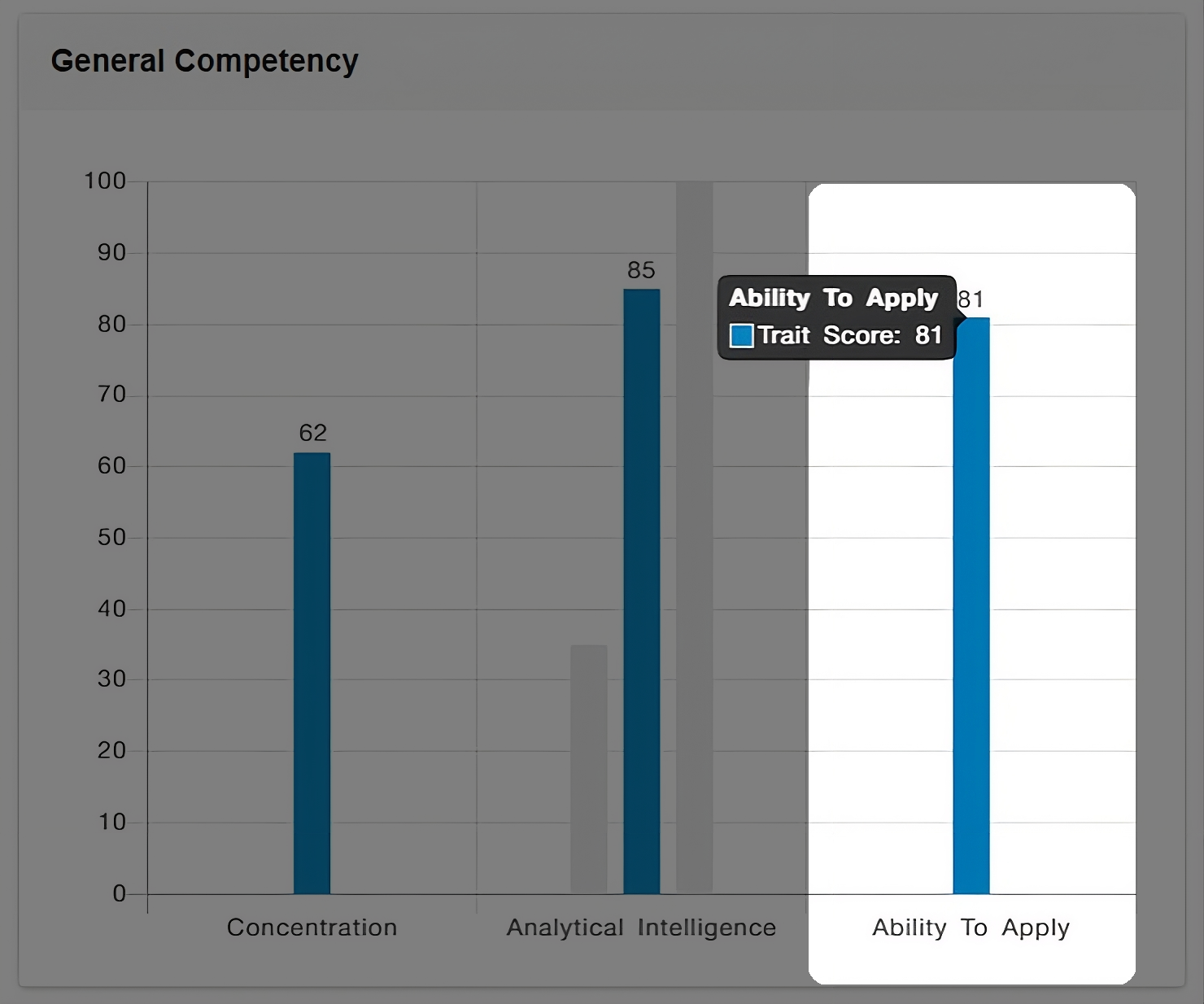
The section overview. Ability to apply is reported in the General Competency chart alongside Concentration and Analytical Intelligence.

Best Practice: Assessment results support your hiring decisions, they do not replace them. Always read the ability to apply trait score alongside the full competency profile and your role benchmarks before drawing a conclusion.
How to Interpret Ability to Apply Results
Your report states the conclusion plainly, noting that because ability to apply is high, this indicates the person is a hard worker. Read the score against the mix of thinking and producing the position actually calls for.
What to Do Based on Your Ability to Apply Score
Interview closely before hiring. Ask how many long days a month the candidate accepts, whether they prefer theory or doing, and then question every answer given.
Under 40 the documented concern is laziness, so run the work ethic questions. Consider whether the position is genuinely a thinking role before ruling anyone out.
Good balance between thinking and producing. Aim for 40 to 55 wherever the role needs steady output, then compare that reading against your role benchmark first.
Expect a visibly busy employee. Check whether that effort is aimed well, since this range can throw time at problems instead of dealing with them effectively.
Workaholic tendencies are likely, so ask about them directly. Remember that readings this high contribute only a tiny part to the overall competency prediction you receive.
Assessment results support decisions, they do not make them. Always interpret scores in context: the specific role, interview performance, references, and your organization's culture.
The Ability to Apply Trait Matters for Every Role You Hire
Some positions reward relentless activity while others reward careful thought, so benchmark this score against the job itself rather than against your other candidates.
Relevant for all role types

Warehouse Associate

Customer Service Representative

Production Operator

Field Service Technician

Inside Sales Representative

Operations Coordinator

Administrative Assistant

Project Engineer
If any of these situations sound familiar, this assessment is for you
Want to see a sample report?
Get a real example of what the IC or SL Behavioral report looks like — scores, trait breakdowns,
and interpretation guidance included.
Not sure which assessment fits? Our team can help you choose based on the role, hiring volume, and depth of evaluation you need. Book a free demo →
Frequently Asked Questions
The ability to apply trait measures the willingness and energy one has to do things and work rather than think about ideas, expressed as how physically busy a person is and how much time they spend at work. It does not measure the skill in applying techniques, so read it as a measure of effort rather than of judgment.
Let Our Team Help You Find the Right Assessment
Tell us which positions you are filling, and we will match the right assessment to them and configure the benchmarks your team should be scoring against.
Learn more about our Assessments
"*" indicates required fields