
Assessments for Existing Employees Read Differently Than They Do for Applicants
Somebody applying for a job and somebody already holding one do not answer the same questionnaire the same way. That difference is not a flaw to work around. It is a known property of the results, and knowing which parts it touches is what makes assessments for existing employees worth running at all.
What Changes When the Person Already Works for You?
An applicant has income and a career riding on the result, so they put their best foot forward and answer the way they think a boss would want. That exaggeration stays consistent, which is what lets the marking correct for it. An existing employee has no such pattern.
Why an employee answers differently
People already in a job take these for their own curiosity or because their employer asked them to. Depending on how secure they feel, they may exaggerate like an applicant or turn unusually honest. The scoring adjusts for that extra honesty and inconsistency so the personality descriptions stay accurate.
What assessments for existing employees help you evaluate

The original integrity questions came from employees already in a job, and that proved inaccurate. Every improvement since has drawn on applicants instead, with follow up six months to two years after the hire.
Why the Difference Matters Before You Test Your Team
Running the same instrument on a current employee is legitimate and useful. Reading the result as though it came from a candidate is where the mistake happens, and the two halves of the report do not shift by the same amount.

Not Every Part Softens
Behavioral types hold up really well on existing employees and competence holds up reasonably well. Only the integrity and attitude side loses any real precision here.

You Already Know the Answer
Most employers can already tell whether their own people have good or poor attitudes. The part that softens here is usually the part you needed least.

One Test Closes the Gap
Pairing the questionnaire with an ability test restores accuracy on both competency and attitude. Without one, the attitude reading stays only generally accurate rather than precise.

How misreading an employee result shows up
Each of these comes from treating an employee result as though a candidate had produced it.
Learn more about our Assessments
"*" indicates required fields
Which Parts of the Result Stay Reliable
The three halves of a report do not degrade equally when the person already works for you. Reading them in this order keeps you on the sturdiest ground first.

The Behavioral Quadrants
Four drives sit behind the quadrant profile, and this is the part of a result that survives the shift best.

Average Emotional Competency
Competency holds up reasonably well on its own here, and an accompanying ability test improves that reading further still afterwards.

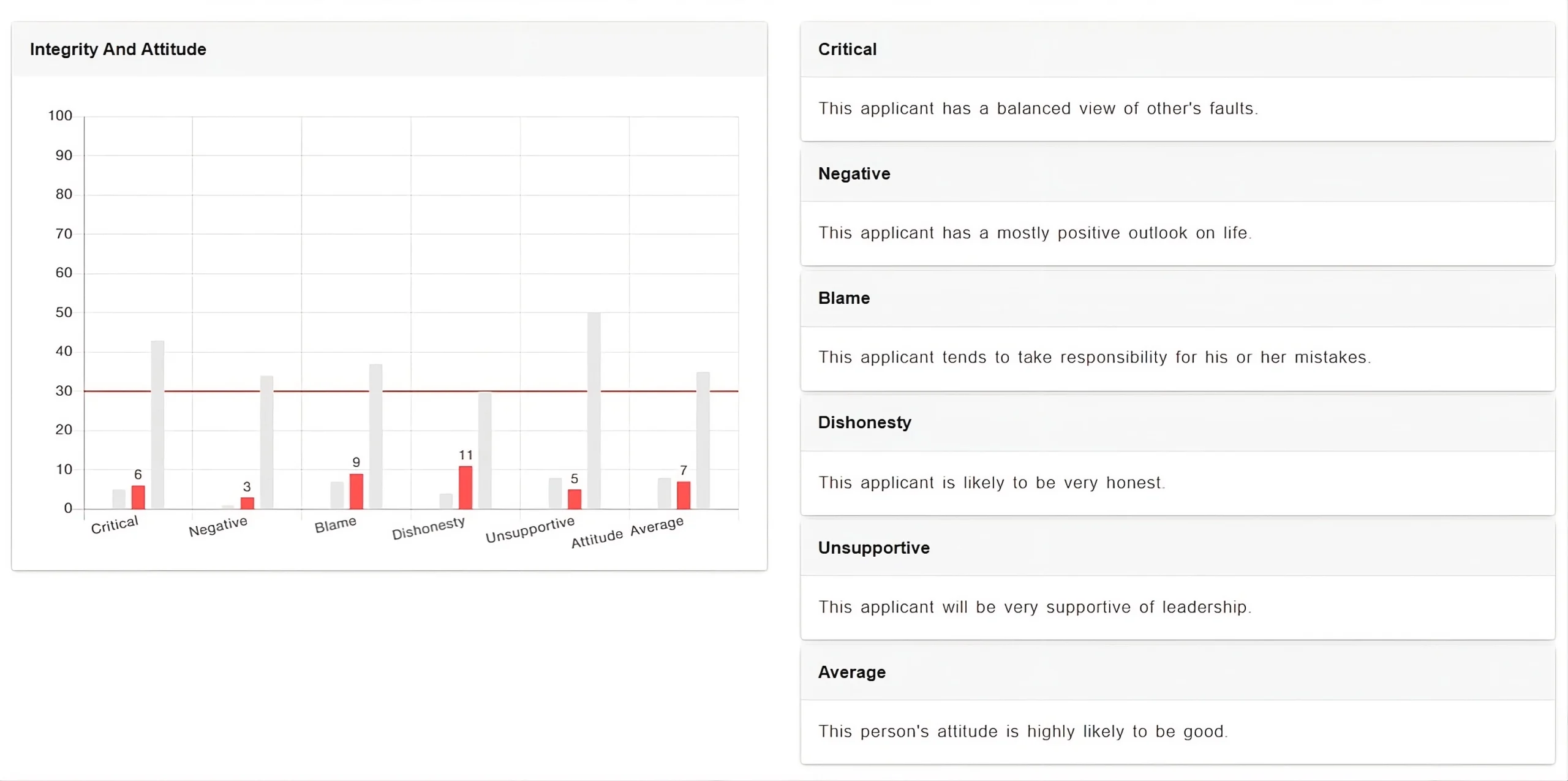
Integrity & Attitude Average
Precision drops furthest on this particular half of the report once the person who answered it already works for you.

Value on the Payroll
The same attitude times competence calculation that guides a hire applies just as directly to somebody who is already employed.

Assessment Manual
The full manual behind every reading on the report, including the quadrants and averages named above.

Best practice: Only somebody who reads these results properly should walk an employee through them, and they should stay in the room. Doing it well takes about two hours, and rushing creates disagreements.
How to Interpret an Existing Employee Result
The scoring already corrects for the way employees answer, so you are not adjusting numbers yourself. What you are adjusting is the weight you give each part, and one particular pattern deserves a second look before you act on it.
Behavioral Types · Reads Really Well
The quadrant profile holds up on employees, which makes placement and fit the safest reading.
Competence · Reads Reasonably Well
General competency survives the shift, and an accompanying ability test makes it more accurate still.
Integrity and Attitude · Reads Less Precisely
Improvements here targeted hiring predictions, so this is the side that softens on an employee.
Why the behavioral read survives
Somebody enhancing their answers lifts every quadrant at once rather than one of them. The shape of the profile therefore stays intact, which is why the personality type stays accurate no matter how low the honesty reading comes back.
Why a very low score can mean the opposite thing
A candidate scoring zero on a trait is a serious signal, and on the decision making trait 80 percent of those applicants turned out to be poor hires even when everything else looked positive. Among existing employees, a much higher share of the zeros are competent people with good attitudes. They are simply less afraid to admit a problem.
What Assessment Honesty tells you about the answers
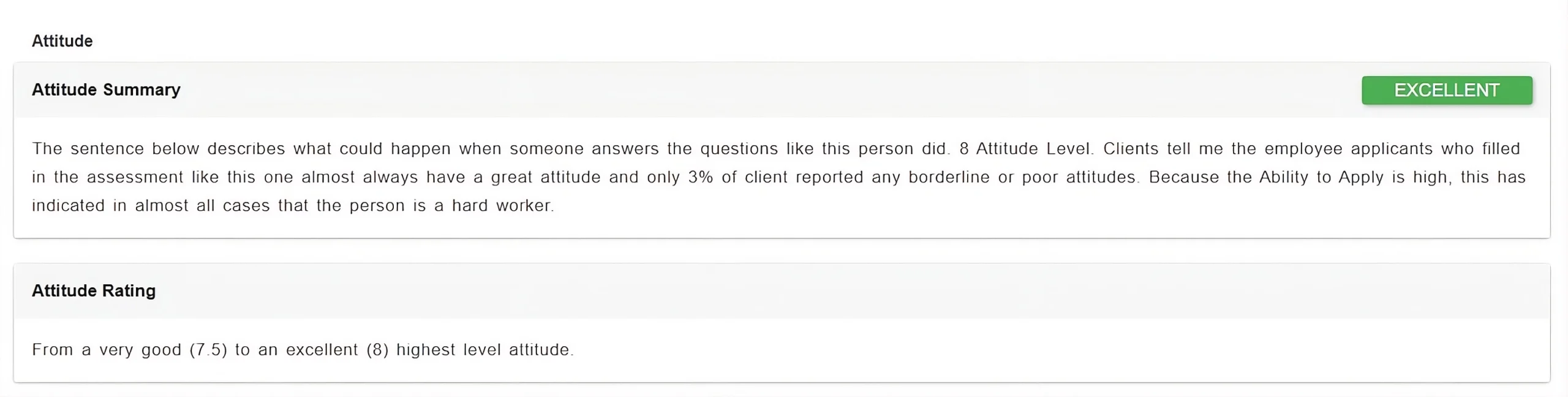
This trait reports how truthfully somebody filled the questionnaire in, and its normal range moves with the reason they took it. Above 22 is normal for a job candidate. Above 50 is normal for somebody answering for their own reasons, which is where most existing employees sit.
The reading also carries a price. Between 8 and 21 the ability to predict drops to roughly 77 percent. Below 8, alongside a low Personal Honesty reading on the SL, competency predictions drop to about 70 percent. Above 72 the person is being hard on themselves, so the marking automatically makes the result more positive to compensate.
Whether an ability test came with it
| With an ability test | Both competency and attitude come back pretty accurate, because the second instrument approaches the person from a different direction. |
| Without an ability test | The attitude level is only generally accurate. Treat it as a direction rather than as a measurement you can act on alone. |
What to Do Based on Why They Took It
Read it the way you would read any candidate result, because applicant norms are the baseline behind the whole marking.
Expect Assessment Honesty above 50 rather than above 22, since that is the normal range for people answering for themselves.
Retaking has not proven useful, and there is too little experience with redone assessments to judge how accurate they are.
What You Can Safely Show the Employee
Results should never go to a candidate, who will argue with them out of denial or misunderstanding. Once somebody is on your payroll the calculation changes, though only part of the report is safe to hand over.
| Safe to share | You can hand an employee the top quadrant chart, the bottom quadrant chart and the overall quadrant chart with relative safety. |
| Never share | The attitude charts, the competency charts and the text page. These stay internal regardless of how the conversation is going. |

Nothing here says the result is wrong. It says the integrity and attitude half carries less precision than the same half would on a candidate, and that an ability test is what closes the distance.
Want to see a sample report?
Get a real example of what the IC or SL Behavioral report looks like — scores, trait breakdowns,
and interpretation guidance included.
What Testing Your Existing Team Is Actually Good For
The instruments work just as well on people already employed as they do on applicants. Two uses in particular are worth the exercise, and both lean on the parts that stay reliable.
Where testing your own team pays off
| Use | Why it works |
|---|---|
| Coaching and Development | Somebody heading into coaching is a named audience here, since the results uncover blind spots in dealing with other people. |
| Placement and Promotion | Behavioral profiles read really well on existing employees, which makes them the soundest basis for deciding where somebody fits next. |
| Value on the Payroll | The same attitude times competence calculation that guides a hire applies just as directly to somebody who is already employed. |
Testing people already on your payroll sits under the same scrutiny as testing applicants. Courts look at an employer's overall selection procedure, which covers hiring, promotion and retention rather than the questionnaire alone.
If any of these situations sound familiar, this assessment is for you
Frequently Asked Questions
Yes. The instruments work just as well on people already employed as they do on applicants. What changes is how much weight each part of the result deserves, not whether the exercise is valid.
Let Our Team Help You Find the Right Assessment
Tell us about the position, hiring volume, and what you need to evaluate — and we'll recommend the exact assessment that fits your process.
Learn more about our Assessments
"*" indicates required fields