
Use the Motivation Trait to Find Candidates Who Take Action and Deliver Results
A candidate can present confidently in an interview and still lack the drive to act when the work requires sustained effort. The Motivation trait measures the actual ability to maintain the energy and interest needed to get things done consistently.

What Is Motivation?
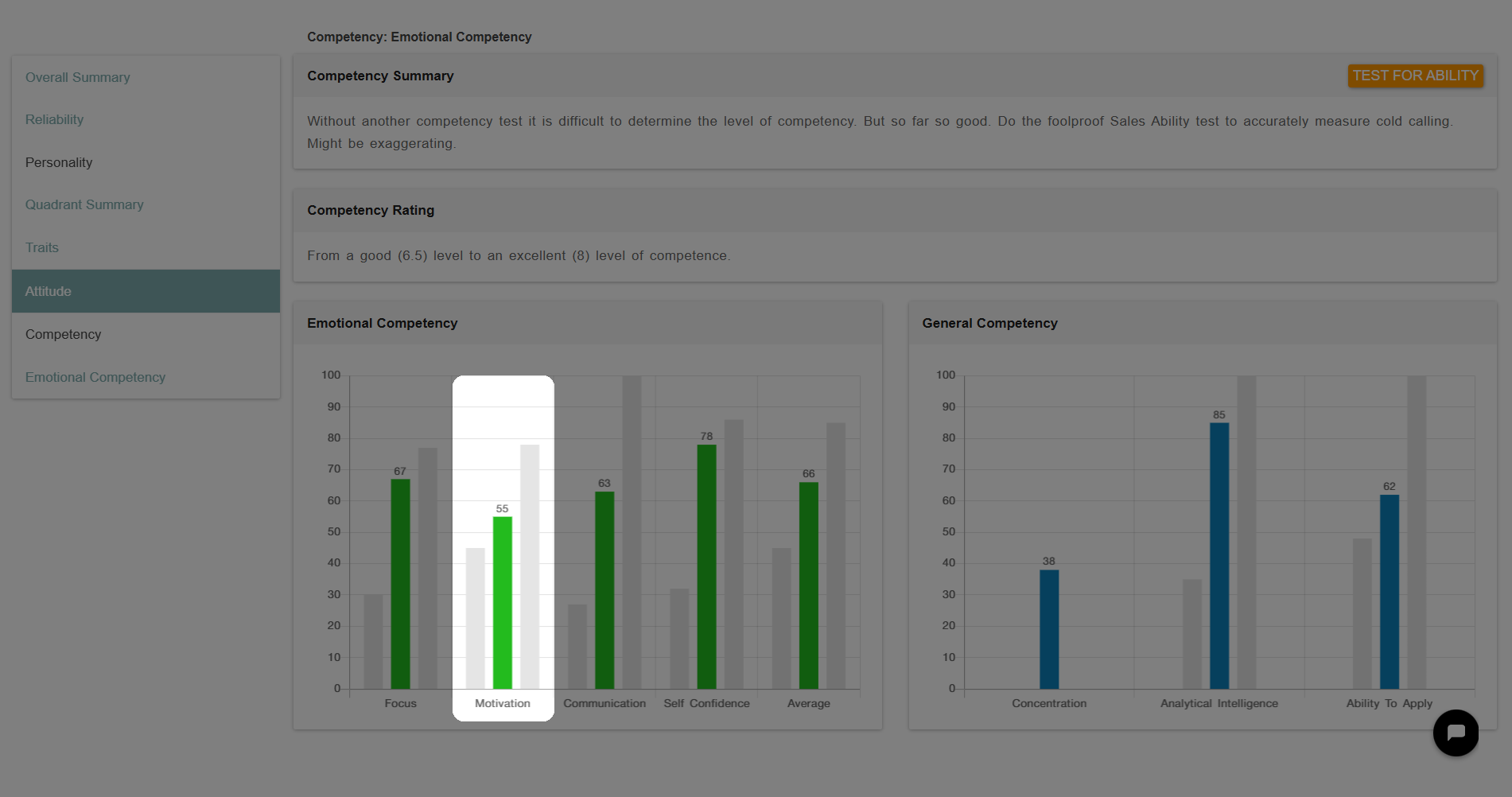
Motivation is one of the four main general emotional competency traits. It is the ability to have enough energy and interest to get things done consistently. Work ethic (whether a person works hard or tends to avoid sustained effort) falls under this trait.
A motivated candidate does not just plan what needs to be done; they take the actions required to deliver results.
Why Motivation Is Hard to See in Interviews
An interview rewards candidates who speak well about what they plan to do. Candidates who lack Motivation can describe ambitious intentions convincingly. The behavioral difference only becomes visible when sustained action is required over weeks and months on the job.
What Motivation Measures

Motivation is not a measure of career ambition or long-term goal orientation. It measures the ability to sustain energy and interest to get things done — covering work ethic and the drive to act.
Why Motivation Matters in Hiring
Low Motivation rarely announces itself. It surfaces as a steady gap between what was discussed and what actually got done — and the cost lands on the people who have to keep following up.

Output Consistency
Motivated employees produce results reliably without needing constant prompting. Employees who lack Motivation require repeated follow-up and still may not deliver at the level the role demands.

Supervision Cost
Low Motivation shifts the burden onto managers. Instead of leading, managers spend their time pushing, reminding, and checking in. This overhead reduces the manager's capacity and frustrates the rest of the team.

Initiative Gap
Unmotivated candidates wait to be told what to do rather than acting independently. In roles that require self-direction, this gap between instruction and action directly limits what the organization can accomplish.
How Low Motivation Shows Up on the Job
Employees with low Motivation may talk about what they intend to do and appear thoughtful about their work. The gap becomes visible in what actually gets done.
Learn more about our Assessments
"*" indicates required fields
How to Read the Motivation Score
Motivation is scored from 0 to 100. The three ranges below give a quick read on what the score means. Use the action guide further down for specific hiring guidance at each level.

The borderline reading is 40, which falls in the medium range of 29 to 45. The high range begins at 45.
Low — 0 to 29
Could lack the energy and drive to sustain effort.
Medium — 29 to 45
Borderline at 40. Depends on role demands.
High — 45 to 89
Has the energy and drive to act and produce results.
How Motivation Connects to Other Scores
Motivation is most informative when read alongside related traits. A single score tells part of the story — reviewing Motivation in combination with the other EC traits gives a fuller picture of execution risk.

Average Emotional Competency (AEC)
Motivation is one of the five traits that make up the AEC composite score. A low Motivation score will pull the AEC lower and may indicate an overall emotional competency concern.

Focus
Closely related to Motivation. Candidates low on both Motivation and Focus are the most at risk for persistent execution problems. When both scores are low, the signal is significantly stronger than either score alone.

Communication (EC)
Both Motivation and Communication (EC) are sub-traits of the AEC. A candidate who communicates well but scores low on Motivation may articulate plans clearly but struggle to follow through on them.

Self Confidence (EC)
Both Motivation and Self Confidence (EC) are sub-traits of the AEC. A candidate who is confident but low on Motivation may project capability while consistently underdelivering on actual output.

Best Practice: When a candidate scores low on Motivation, probe their work history for evidence of self-directed action. Ask: “Other than study, what else do you do to improve your efficiency at work?” Listen for concrete actions rather than general statements.
What to Do Based on Your Results
Your next step depends on where the score falls. The action guide below gives specific hiring guidance for each range, and the borderline reading at 40 means a medium score should always be weighed against how much self-direction the role demands.
Action guide by score range
Could lack the drive to follow through consistently. May plan or discuss tasks without executing. Review work history for evidence of self-directed action before proceeding.
Below 10 (extreme low): very likely lacks the energy and interest needed to take action. Scores in this range are extremely rare and represent a significant concern for any role.
Borderline at 40. Motivation level is uncertain. A medium score may be acceptable for some positions and a concern for others depending on the role's demands for self-direction.
Has the energy and drive to take action and get things done. Will work hard to produce results consistently. The target range for virtually all positions.
Assessment results support decisions, they do not make them. Always interpret scores in context: the specific role, interview performance, references, and your organization's culture.
Which Roles Depend on Motivation
High Motivation is relevant for virtually all job positions. Any role that requires consistent output, independent action, or sustained effort over time depends on this trait.
Relevant for all role types

Sales representative
Must maintain the drive to prospect, follow up, and close without relying on external pressure.

Customer service representative
Must sustain energy and attentiveness across repeated interactions throughout the day.

Operations coordinator
Must execute on a high volume of tasks consistently without losing momentum.

Administrative assistant
Must maintain effort and follow-through across many small tasks that add up to significant output.

Account manager
Must independently manage client relationships and deliverables without daily direction.

Remote or independent-contributor roles
Require self-direction and sustained effort without a manager physically present.
If any of these situations sound familiar, this assessment is for you
Want to see a sample report?
Get a real example of what the IC or SL Behavioral report looks like — scores, trait breakdowns,
and interpretation guidance included.
Not sure which assessment fits? Our team can help you choose based on the role, hiring volume, and depth of evaluation you need. Book a free demo →
Frequently Asked Questions About the Motivation Trait
It indicates the candidate may lack the energy and interest needed to consistently take action. They may spend time thinking or planning but not follow through with the effort required to produce results.
Let Our Team Help You Find the Right Assessment
Tell us about the position, hiring volume, and what you need to evaluate — and we'll recommend the exact assessment that fits your process.
Learn more about our Assessments
"*" indicates required fields