
Use the Focus Trait to Identify Candidates Who Prioritize and Execute
The Focus trait reveals whether a candidate can place attention on the right priorities and follow through or stay busy without producing results. This trait measures the actual capacity to prioritize, listen to what is needed, and get the most important tasks done consistently.

What Is Focus?
Focus is one of the four main general emotional competency traits. It is the ability to place attention on the most important priorities and get them done, combined with the ability to listen to others and understand what is actually required.
Why Focus Is Hard to See in Interviews
Candidates who lack Focus often present well in structured conversations. An interview is a short, high-stakes interaction where the candidate is primed and attentive. The real pattern of going from activity to activity, missing key deliverables, or working on non-essential tasks only appears under normal working conditions over time.
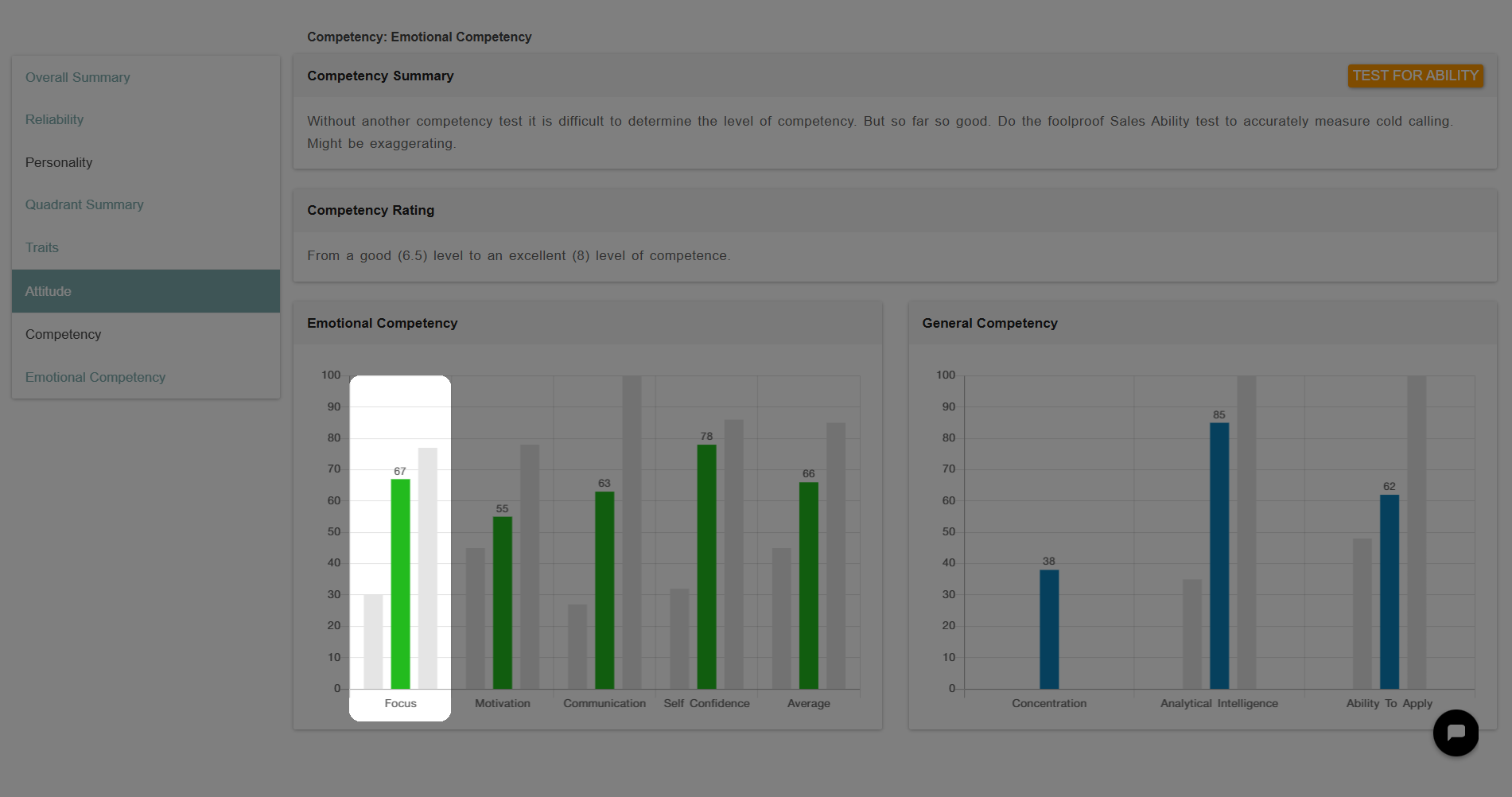
What Focus Measures

Note: Focus is closely related to Concentration. Both traits measure the ability to maintain attention on what matters, but they are distinct scores in the assessment.
Why Focus Matters in Hiring
Focus rarely fails loudly. It shows up as effort that does not convert into results — work that looks busy from the outside while the tasks that actually matter go unfinished.

Execution Gap
Candidates who lack Focus may appear productive but consistently fail to complete the tasks that matter most. Work accumulates, deadlines slip, and output does not match the effort put in.

Management Overhead
When an employee cannot self-direct their attention, managers must regularly redirect, re-prioritize, and follow up. This overhead compounds across teams and reduces the manager's own capacity.

Priority Alignment
Unfocused candidates tend to spend time on non-essential tasks. One client reported a candidate with a Focus score of 39 and a Concentration score of 40 as someone who focuses on tasks that are non-essential.
How Low Focus Shows Up on the Job
Employees with low Focus do not necessarily appear disengaged. They may look busy and report feeling productive. The gap becomes visible in results: tasks that are started but not completed, work that addresses the wrong priorities, and a pattern of being easily sidetracked.
Learn more about our Assessments
"*" indicates required fields
How to Read the Focus Score
Focus is scored from 0 to 100.
The three ranges below give a quick read on what the score means. Use the action guide further down for specific hiring guidance at each level.

The borderline reading for Focus is 50, which falls in the medium range of 46–60. The high range begins at 60.
High — 60 to 100
Can place attention on priorities and follow through.
Medium — 46 to 60
Borderline. Depends on role demands.
Low — 0 to 45
Could lack the ability to prioritize and execute.
How Focus Connects to Other Scores
Focus does not operate in isolation. The score is most informative when read alongside related traits in the full assessment profile.

Self Confidence (EC)
Both Focus and Self Confidence (EC) are sub-traits of the AEC. A candidate who scores high on Self Confidence but low on Focus may initiate well but lose direction once the initial drive fades.

Concentration
The trait most closely related to Focus. Both measure the ability to maintain attention on what matters. A pattern of low scores on both traits is a stronger signal of execution difficulty than a low score on either one alone.

Motivation
Candidates low on both Focus and Motivation often struggle most with follow-through and independent task completion. When both scores are low, execution risk is significantly elevated.

Communication (EC)
Both Focus and Communication (EC) are sub-traits of the AEC. Candidates who score high on Communication but low on Focus may express ideas well but struggle to act on them in a sustained or organized way.
Average Emotional Competency (AEC)
Focus is one of the five traits that make up the AEC composite score. A low Focus score will pull the AEC lower and may flag an overall emotional competency concern.

Best Practice: Do not rely on the Focus score alone. An extremely high “ability to apply” trait can appear alongside a Focus weakness, so review the full trait profile before drawing conclusions.
What to Do Based on Your Results
Your next step depends on where the score falls. The action guide below gives specific hiring guidance for each range, and the borderline reading at 50 means a medium score should always be weighed against what the role actually demands.
Action guide by score range
Very likely lacks the ability to listen to what is needed or place attention on the right priorities. Scores in this range are extremely rare.
Could lack the ability to prioritize and follow through. May appear busy but redirect effort toward non-essential tasks. Weigh carefully against role demands.
Borderline at 50. Ability to focus is uncertain. A medium score may be acceptable for some positions and a concern for others depending on the role's demands.
Can listen to what is needed, place attention on the most important priorities, and get them done. The target range for most roles that require sustained, independent work.
Assessment results support decisions, they do not make them. Always interpret scores in context: the specific role, interview performance, references, and your organization's culture.
Which Roles Depend on Focus
Focus is relevant for almost every position. Any role that requires completing tasks, meeting deadlines, or responding to direction from others has a meaningful dependency on this trait.
Relevant for all role types

Sales representative
Must stay focused on revenue-producing activities rather than low-value tasks.

Technical roles
Require sustained attention to complete complex work accurately.

Administrative assistant
Must prioritize multiple competing requests and execute on them.

Data analyst
Requires concentrated effort on the right data questions, not tangential ones.

Operations coordinator
Must manage priorities across multiple workstreams simultaneously.

Customer service representative
Must listen accurately and respond to what the customer actually needs.
Roles where Focus is especially critical
Want to see a sample report?
Get a real example of what the IC or SL Behavioral report looks like — scores, trait breakdowns,
and interpretation guidance included.
Not sure which assessment fits? Our team can help you choose based on the role, hiring volume, and depth of evaluation you need. Book a free demo →
Frequently Asked Questions About the Focus Trait
It means the candidate may have difficulty placing attention on the most important priorities. They may stay busy and look productive but redirect their effort toward non-essential tasks instead of what is required.
Let Our Team Help You Find the Right Assessment
Tell us about the position, hiring volume, and what you need to evaluate — and we'll recommend the exact assessment that fits your process.
Learn more about our Assessments
"*" indicates required fields