
The Attention to Detail Trait Measures Desire for Precision Before You Hire
The attention to detail trait is one of four dimensions in the Analyzer and Logical quadrant of the Behavioral Assessments. It tells you who will happily spend hours on the fine points and who gets frustrated by them within minutes.

What Does the Attention to Detail Trait Measure?
The attention to detail trait measures the desire or willingness to do the minute yet important aspects of a task. In other words, it scores the willingness to check and recheck work for the smallest mistakes.
What the attention to detail trait is not
It does not measure the ability to do detail correctly, or to catch mistakes. Desire and skill come apart often enough that a separate ability test exists to measure the skill directly. Even so, people who enjoy detail usually turn out to be good at it.
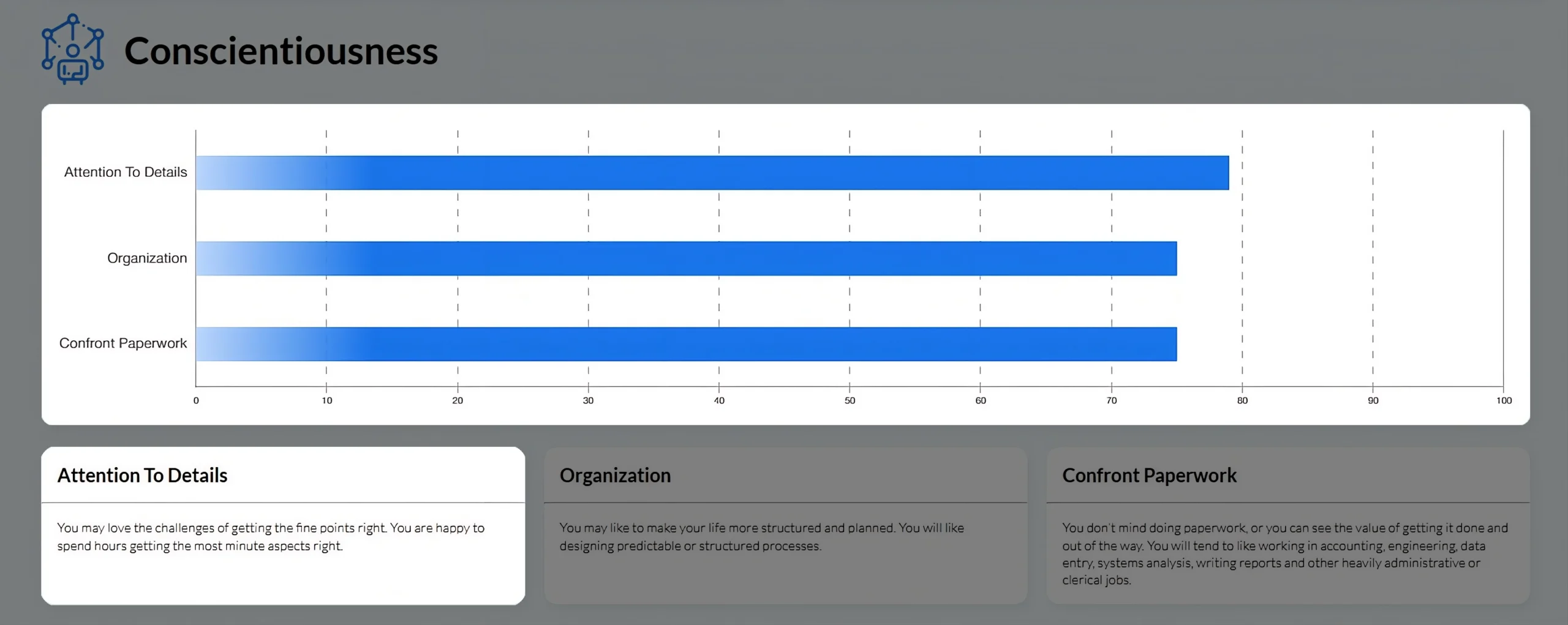
What the Attention to Detail Trait Helps You Evaluate Before You Hire

Run the ability test when detail really counts. The assessment recommends the detail ability test whenever a position depends on detail and the candidate scored poorly for detail on the aptitude assessment. This trait covers desire. That test covers skill.
Why the Attention to Detail Trait Matters in Hiring
The attention to detail trait scores an appetite, not an aptitude. Because precision pays off in some departments and slows others down, the same reading can recommend a candidate in one role and rule them out in the next.

Low Is Common in Leaders
The assessment calls a low reading common among big picture leaders, and advises making sure somebody else is actually available to take on the detail work.

Desire, Not Skill
Some managers do detail work accurately and dislike every minute of it. The assessment separates the two, so read this score as intent rather than capability.

High Misses the Big Picture
High scorers happily spend hours getting the minute aspects right. The assessment warns they can get so wrapped up in details they miss the bigger picture.

How a mismatched Attention to Detail score shows up on the job
The reading surfaces the moment precision starts costing time. Consequently, one end of the scale slows the work down and the other lets errors through.
Learn more about our Assessments
"*" indicates required fields
How the Attention to Detail Trait Is Scored
The attention to detail trait is scored from 0 to 100, and the three bands below summarize the picture. Because precision helps in some positions and slows others down, your benchmark for the role decides what a strong score looks like.

This trait scores desire, not ability. When a position genuinely depends on precision, the assessment recommends running the separate detail ability test alongside it rather than reading this number on its own.
Low — 0 to 39
Does not want to mess with the fine points, and gets frustrated with the need to be exact. The assessment states these people often do well in people-facing work.
Medium — 40 to 60
Shows a good balance between the details and the overall picture. The assessment clears this range for most positions and states plainly that it would not adversely affect any position.
High — 61 to 100
Loves getting the fine points right and will spend hours doing it. Above 91 the same focus means getting so wrapped up in the details that the bigger picture disappears.
Attention to Detail is one of four traits measured together in the Analyzer and Logical quadrant
Each trait in this quadrant shapes how candidates handle exacting work, and moreover three of them combine into a warning the assessment states outright.

Organization
The assessment calls Organization similar but slightly different. A low reading on both, plus low Confront Paperwork, points to reluctant administrators or reluctant highly technical people.

Confront Paperwork
Confront Paperwork covers willingness to complete paperwork without procrastinating. The assessment names it closely related, and it forms the third leg of the administrator warning.

Concentration
The assessment names Concentration closely related. Concentration covers holding attention on one task, so a strong desire for precision needs the staying power to deliver it.

Reliable
Reliable covers the urge to keep commitments and arrive on time. Precision means little without follow-through, so read the pair together for any technical position.
Analyzer / Logical Quadrant
The Analyzer / Logical Quadrant groups this reading with Organization, Confront Paperwork and Reliable, forming the methodical and exact profile.

Best Practice: Assessment results support your hiring decisions, they do not replace them. Always read the attention to detail trait score alongside the full profile and your role benchmarks before drawing a conclusion.
How to Interpret Attention to Detail Results
Interpretation depends on how much precision the position actually demands. Both Behavioral Assessment versions report this trait, and Work Styles DISCovered reports it as well.
What to Do Based on Your Attention to Detail Score
Acceptable for people-facing work, with no attitude concern. If this candidate leads, make sure somebody else takes the detail, and check Organization and Confront Paperwork.
Often strong in sales, customer service and people-facing jobs. Common among big picture leaders, so confirm the team already covers the detail this person avoids.
A good balance between details and the overall picture, and the assessment states this range would not adversely affect any position. Compare it against the quadrant.
Excellent for engineering, estimating, technical work, order entry, accounting and administrative support roles. Confirm somebody else keeps the bigger picture in view while this person works.
Expect hours spent on the most minute aspects, with no attitude concern. Watch for a candidate who perfects the small thing while the larger goal drifts.
Assessment results support your hiring decisions, they do not replace them. Always read the attention to detail trait score alongside the full profile and your role benchmarks before drawing a conclusion.
The Attention to Detail Trait Matters for Every Role You Hire
Because the same score reads as a strength in one department and a bottleneck in another, benchmarks define what it means. Therefore, review results against the benchmark for the specific job.
Roles where Attention to Detail is especially critical
| Role | Why it matters |
|---|---|
| Engineering and Technical | The assessment names engineers, estimators and technicians among the positions high scorers fill well, since these roles reward hours spent getting the minute aspects exactly right. |
| Accounting and Admin | Accounting people, administrative assistants and order entry workers all appear in the assessment's list of jobs suited to the upper ranges, where rechecking is the job. |
| Sales and Service | The assessment states low scorers often do well in sales, customer service and jobs dealing with people. A low reading is no reason to reject them. |
| Leadership Roles | A low reading is common among big picture leaders. The assessment advises confirming that somebody else can absorb the detail work before you make the offer. |
Relevant for all role types

Quality Inspector

Account Executive

Accounting Clerk

Sales Representative

Operations Manager

Estimator

Order Entry Specialist

Customer Service Rep
If any of these situations sound familiar, this assessment is for you
Want to see a sample report?
Get a real example of what the IC or SL Behavioral report looks like — scores, trait breakdowns,
and interpretation guidance included.
Not sure which assessment fits? Our team can help you choose based on the role, hiring volume, and depth of evaluation you need. Book a free demo →
Frequently Asked Questions
The attention to detail trait measures the desire or willingness to do the minute yet important aspects of a task. In short, it scores the willingness to check and recheck work for the smallest mistakes, rather than the accuracy somebody achieves while doing so.
Let Our Team Help You Find the Right Assessment
Tell us which positions you are filling, and we will match the right assessment to them and configure the benchmarks your team should be scoring against.
Learn more about our Assessments
"*" indicates required fields