
Find Out If a Candidate Will Actually Close Deals with the Sales Traits Assessment
Every sales candidate can describe a good process, and most describe one well. The sales traits test something an interview cannot reach. It is whether somebody picks the right move when a real situation lands in front of them.

What Are Sales Traits?
The sales traits sit inside the Sales Ability Test, which measures natural and learned competency related to selling. Each trait draws on the sales knowledge questions and on the people knowledge that selling depends on.
*Consequently, a trait can reach across more of the test than its name suggests.
Why Sales Traits Are Invisible in Interviews
Every sales candidate knows how to sell themselves in an interview. They are motivated, confident, and articulate about their process. What the interview does not reveal is whether that performance reflects genuine behavioral drive or a well-prepared presentation. Most weak salespeople interview very well.
What Sales Traits Help You Evaluate Before You Hire

Not all sales roles require the same behavioral profile. Use the Sales Traits results to identify whether a candidate's drives align with the specific type of selling the position requires, whether that is new business development, account management, or high-volume inside sales.
Why Sales Traits Matter in Pre-Employment Screening
Sales candidates are the hardest group to read in an interview, because performing well in a structured conversation is part of the job itself. These traits describe what happens once the novelty of a new territory wears off.

Knowledge, Not Presentation
Presentation is not knowledge. These scores report what a candidate chose from five options, and not how well they later explained the choice in an interview.

Role-Type Fit
The results show which type of selling a candidate is likely to do best at. That matters because hunting, closing and account work reward different knowledge.

It Works After the Hire
Because the test uncovers blind spots in sales and people knowledge, it doubles as a coaching tool. Existing employees can take it as usefully as applicants.
How a sales knowledge gap shows up on the job
The decline is gradual and easy to misdiagnose. Each symptom below tends to be treated as a training problem long before anybody questions behavioral fit.
Learn more about our Assessments
"*" indicates required fields
Sales Traits That Show Which Kind of Selling a Candidate Knows
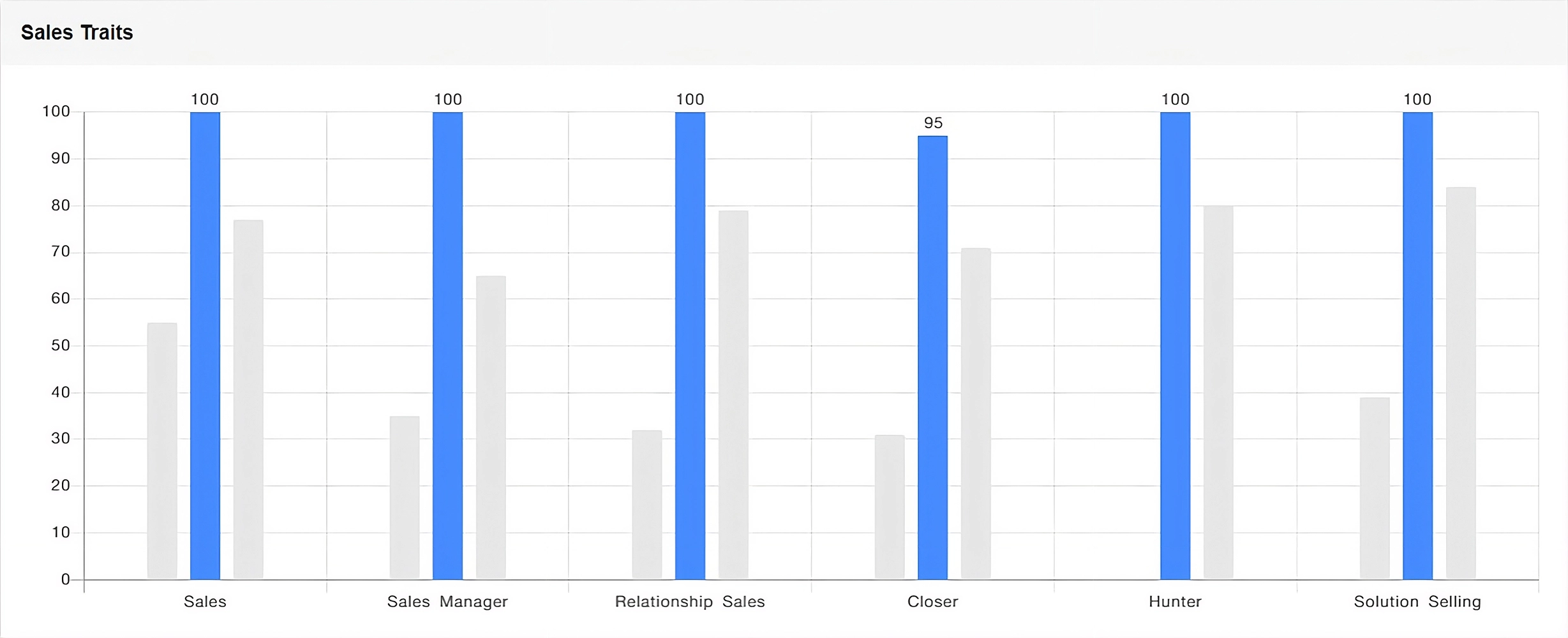
Sales Ability Assessment measures people, sales and logic, and the six traits below make up its sales side.
Each one scores theoretical understanding, so each answers a narrower question than the overall number does.

Sales (General Sales)
Theoretical understanding of the best ways to persuasively market themselves, products or services, and to close sales. It is not the ability to apply those techniques.

Sales Manager
Indicates the candidate's theoretical understanding of marketing, closing and managing salespeople, drawn from people knowledge and general sales know how.

Relationship Sales
Reflects the candidate's theoretical understanding of how to build lasting relationships with existing customers and encourage repeat business.

Closer
Measures the candidate's theoretical understanding of the strongest approaches to closing a sale. It is not the ability to market themselves, a product or a service, which sits separately.

Hunter
Indicates the candidate's understanding of the best ways to find and win new business, through unsolicited cold calls, door to door selling and other approaches to complete strangers.

Solution Selling
Reflects the candidate's belief that effective selling means understanding the customer's problem and presenting the offering as the right low-pressure solution.

Best Practice: Match each candidate's strongest traits to the specific demands of the role. A profile suited to Relationship Sales will consistently underperform in a Hunter role even when the composite Sales Traits score looks comparable.
Most Sales Failures Are Behavioral, Not Technical
A Harvard Business Review study of 1,000 top B2B salespeople found that the behavioral traits separating top performers from average ones were consistent and measurable before hire.
Technical product knowledge appeared in both groups. What separated quota-achievers was behavioral: how they handled rejection, pursued new business, and sustained activity without external pressure.
85%
Conscientiousness: disciplined follow-through and pipeline management
84%
Achievement orientation: internal drive to reach and exceed targets
90%
Emotional resilience: recover quickly from rejection and objections
82%
Curiosity: ask questions, understand the buyer, diagnose before pitching
Not a differentiator
Technical knowledge: present in both top and average performers, not a differentiator
Steve W. Martin · Harvard Business Review · Study of 1,000 top B2B salespeople · Salesforce State of Sales 2026 · HubSpot State of Sales 2026
How to Interpret Sales Traits Results
The overall score runs across fifty multiple choice questions. Twenty two cover people knowledge and thirteen cover pure sales know how. The rest are logic and deduction problems.
The three bands below group the six named ranges, and they describe the overall score rather than any single trait.
Low
Core sales and people competency is absent or well below the threshold needed for most sales roles.
Borderline
Basic sales competency is present but falls short of reliable performance in aggressive or managerial sales roles.
Strong
Sales competency is solid and consistent. These candidates have the foundational ability for productive performance across most sales environments.
*Each trait carries its own ranges, which differ from these and from each other.
What to Do Based on Your Results
This score indicates the candidate was guessing or lacks foundational sales and people knowledge. Do not advance for any sales role without a structured competency evaluation to identify where the gaps are concentrated.
A low average is a poor overall result. While individual traits may be acceptable for specific sales roles, the composite result warrants careful review of benchmarks before proceeding to the next stage.
Borderline scores fall below the threshold associated with effective sales management. For general sales roles, review individual trait benchmarks to determine whether any area is strong enough to support the specific position.
An OK result is serviceable for non-aggressive sales roles. If people skills are stronger than the logic side of the score, this candidate may perform well in relationship-based positions but is unlikely to be suited for sales management.
A Good score indicates the candidate is generally competent and likely to be a solid producer. Review individual trait benchmarks to confirm the right placement, as aggressive outreach or senior sales roles may require scores closer to the Excellent range.
An Excellent score predicts strong overall sales competency. These candidates have the foundational ability for demanding sales roles. Review individual traits to confirm where their strengths are highest before finalizing placement.

Assessment results support your hiring decisions, they do not replace them. Always read the Sales Traits score alongside the full profile and your role benchmarks before drawing a conclusion.
Which Assessments Evaluate Sales Traits?
One test produces these six traits, and a second one is worth running beside it.
The pairing is what closes the gap between what a candidate knows and how a candidate behaves.

Sales, People & Logic Assessment Test
The instrument that produces all six sales traits, alongside people and logic readings. Give it to anyone whose job is to sell or promote a service.

Sales & Leadership (SL) Behavioral Assessment
The behavioral counterpart to this test. Hunter in particular needs the SL beside it, since calling comfort and cold calling willingness sit outside a knowledge score.
Want to see a sample report?
Get a real example of what the Sample Sales Ability report looks like — scores, trait breakdowns,
and interpretation guidance included.
Not sure which assessment fits? Our team can help you choose based on the role, hiring volume, and depth of evaluation you need. Book a free demo →
Who Should Take the Sales Traits Assessment?
The Sales Ability Test is built for sales-driven roles at every level. Below are the positions this assessment is most commonly used to evaluate.
Roles where Sales Traits are especially critical
High scores in competitiveness and assertiveness most directly predict performance in these sales and leadership positions:
| Role | Why it matters |
|---|---|
| Salesperson (Hunter or Closer) | High competitiveness is the defining trait for salespeople who actively pursue prospects and push deals to close, and this assessment measures exactly that behavioral drive. |
| Inside Sales Representative | Assertiveness and competitive drive determine output in high-volume environments where self-motivation is the primary performance variable. |
| Outside Sales Representative | Competitiveness predicts who will prospect independently, push through rejection, and maintain activity without external direction. |
| Account Executive | Growing and protecting a book of business requires the assertiveness to ask for more and the competitive nature to defend accounts when challenged. |
Relevant for all role types

Inside and Outside Sales

Sales Management and Leadership

Account Management

Business Development
Retail and Direct Sales

Telemarketing and Phone Sales

Solution and Relationship Selling

Revenue Operations and Strategy
If any of these situations sound familiar, this assessment is for you
Frequently Asked Questions
It measures three distinct areas: knowledge of people behavior and how to deal with others (22 questions), sales knowledge specific to the sales process (13 questions), and logical reasoning ability (15 questions). All 50 questions are multiple choice. The test does not measure personality types or career interests, though results often confirm them.
Ready to Build a Sales Team That Performs?
The Sales Ability Test surfaces who has the competitive drive and sales knowledge to hit quota before you make the hire.
Learn more about our Assessments
"*" indicates required fields