
The Logic Traits Measures How a Candidate Reasons, Deduces, and Solves Problems
The Logic Traits section measures how well a candidate reasons through problems, recognizes meaningful differences in information, and reaches sound conclusions. The scores reflect day-to-day operational reality rather than a candidate's ability to perform well during a short period.

What Are Logic Traits?
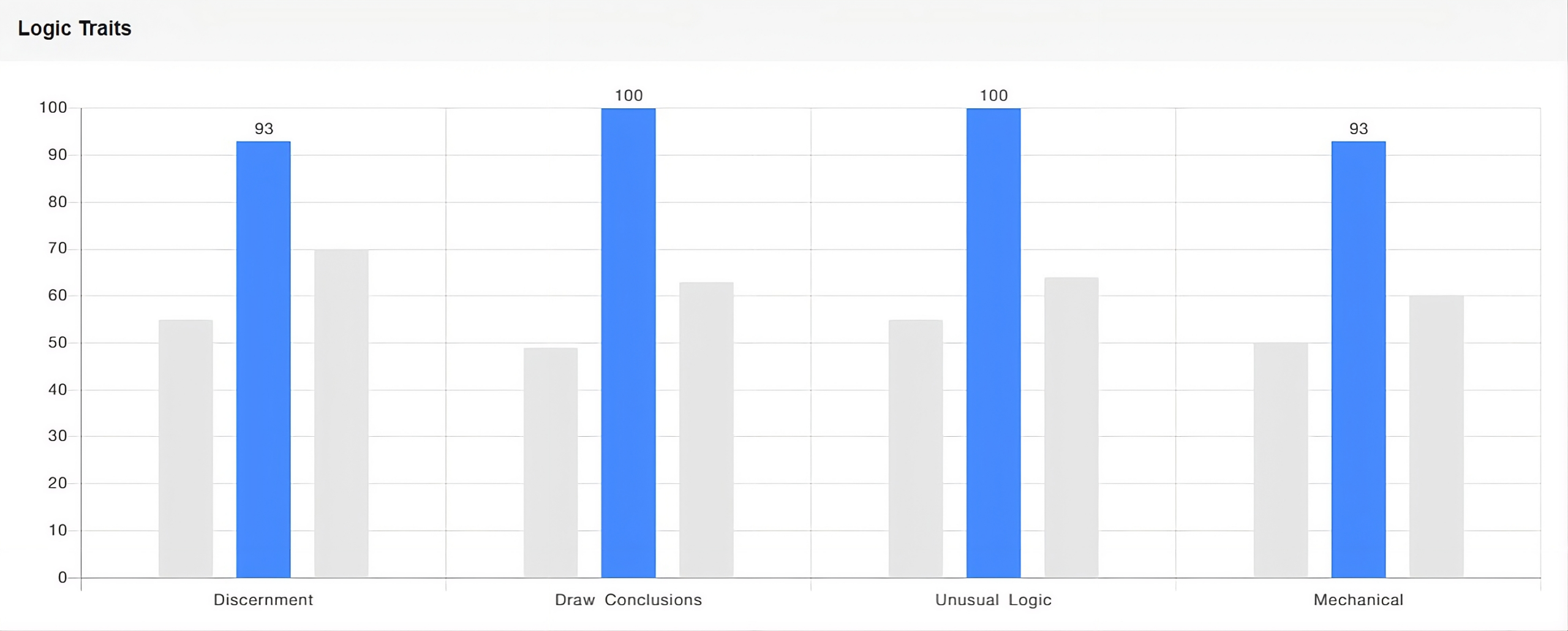
The Logic Traits section groups the four analytical traits that measure how a candidate handles information and works through problems.
The result therefore measures reasoning ability directly, not a candidate’s stated preferences or habits.
Why Logic Traits Are Hard to Read in Interviews
A candidate can describe a structured approach to problem solving fluently and still struggle to work through an unfamiliar problem. The interview rewards the explanation; the assessment scores the solution. That gap is why two candidates who interview equally well often perform very differently once the work stops being hypothetical.

What Logic Traits Help You Evaluate Before You Hire

A candidate who scores low on Logic Traits is not necessarily a poor hire. Many strong performers succeed on people skills, drive, or hands-on experience rather than analytical reasoning.
*Use the result to match the candidate to work that plays to what they actually do well.
Why Logic Traits Matter in Pre-Employment Screening
Structured-work preferences do not announce themselves during hiring.
They surface later, as reliability, supervision load, and long-term fit.

Decision Quality
Weak reasoning produces confident decisions built on the wrong conclusion. The error is rarely visible when it is made, only in what it costs later on.

Supervision Cost
A candidate who cannot work a problem through alone routes it back upward. That time gets spent on correction rather than on developing the team itself.

Role Ceiling
Detail-driven roles require candidates who find structure genuinely sustainable. Mismatched hires create quality risk.

How a Logic Trait Mismatch Shows Up on the Job
These patterns rarely appear in the interview. They emerge once the candidate is managing their own workload.
Learn more about our Assessments
"*" indicates required fields
The Four Analytical Traits Behind the Logic Traits Score
Each trait measures a different dimension of how a candidate processes information and works through problems. Unusual Logic carries the most weight of the four and is the one to read first.

Discernment
Measures the ability to recognize similar types of detail among dissimilar ones, and to see when something belongs in a different category.

Draw Conclusions
Reflects the ability to figure out a correct assumption from the information given, and to make accurate deductions from incomplete data.

Unusual Logic
Indicates the candidate's ability to see problems from unconventional angles and identify solutions that are not immediately obvious.

Mechanical Logic
Measures the candidate's natural and learned ability to reason through mechanical problems and understand how things work.

Best Practice: Read Unusual Logic first, then the other three. A candidate can score well on Discernment and still miss the angle that solves an unfamiliar problem, which is the ability most analytical roles actually depend on.
Placing the Wrong Person in a Precision Role Has a Cost That Compounds
SHRM estimates the cost of a bad mid-level hire at 100 to 150% of annual salary once errors, rework, supervision time, and eventual replacement are included.
For roles where precision is the core deliverable, that cost does not arrive as a single event. It compounds quietly through errors that grow more expensive the further they travel before detection.
$1 – $5
Caught at entry: immediate correction before any downstream impact
$10 – $25
Found during reconciliation: requires review and rework of related records
$50 – $100
Detected before delivery: involves multiple stakeholders and process steps
$500+
Reaches client or compliance: formal correction, potential liability
Ongoing
Undetected and compounding: embedded in systems or records over time
Cost of a precision error by detection stage. Sources: SHRM · LinkedIn Workforce Research · Lido — Data Entry Error Rate Research
How to Interpret Logic Traits Results
The Logic Traits average score reflects how well a candidate can reason analytically, solve logical problems, and think outside the box.
The three bands below consolidate the six defined score ranges into broad performance tiers to orient your interpretation before reviewing the full breakdown.
Low Score (0–40)
General competency is absent or unreliable, and sits well below the range where capable supervisors and managers are normally found.
Borderline Score (41–55)
Competency is present but falls short of what problem-solving and people-facing roles need a candidate to handle without help.
Strong Score (56–100)
Competency is consistent and reliable across the senior, supervisory, and analytical roles this test is most often used for.
What to Do Based on Your Results
This score indicates the candidate was guessing or lacks foundational analytical ability. Do not advance for roles requiring structured problem-solving or logical reasoning without a targeted competency evaluation.
A low average signals limited analytical competency across the logic traits. Review individual scores to determine whether any dimension is strong enough to support the specific role before advancing.
Borderline scores fall below the threshold associated with effective analytical performance. For roles requiring supervision, project management, or technical problem-solving, treat this result as a meaningful concern.
An OK average is acceptable for general-purpose roles with moderate analytical demands. Confirm that the role's accuracy and organizational requirements align with this level of competency before advancing the candidate.
A Good score indicates the candidate is generally competent in structured, analytical work. Review individual trait scores to confirm that the strongest areas match the specific analytical demands of the role.
An Excellent score indicates strong and consistent analytical competency. These candidates are well-suited for roles requiring precision, structured reasoning, and reliable performance under complexity. Review individual traits to confirm best placement.

Assessment results support decisions — they don't make them. Always interpret scores in context: the specific role, interview performance, references, and your organization's culture. No single score should be a standalone disqualifier.
Which Assessments Evaluate Logic Traits?
Logic Traits are reported on three tests.
The People & Logic Competency Test carries all four traits, the Sales Ability Test carries three, and the standalone Logic Assessment Test measures reasoning on its own.

Aptitude & People Skills Assessment Test (IC Ability)
Combines analytical reasoning with a read on how well a candidate understands and handles people. It is the only one that reports all four Logic Traits, giving the broadest view of general competency. Best where a role carries responsibility for people as well as for decisions.

Sales, People & Logic Assessment Test
Reads analytical reasoning alongside sales knowledge and an understanding of people behavior. It reports Discernment, Draw Conclusions and Unusual Logic, though not Mechanical. Best where a candidate has to reason in real time in front of a customer rather than at a desk.

Logic Assessment Test
Isolates analytical reasoning, with nothing from the people or sales side mixed in, which makes it the cleanest read on problem-solving ability by itself. Best for technical candidates whose work is analytical and who will be solving problems largely on their own.
Want to see a sample report?
Get a real example of what the Sample IC Ability report looks like — scores, trait breakdowns,
and interpretation guidance included.
Not sure which assessment fits? Our team can help you choose based on the role and its analytical demands.
Who Should Take the Logic Traits Assessment?
The People & Logic Competency Test and the Logic Assessment Test are built for analytical roles.
They suit work where the cost of a wrong conclusion is high enough to matter to the business.
Role families where Logic Traits apply
Engineering and technical fields

Accounting and finance

Administrative and clerical roles

Data and systems work

Project and operations management
Estimating and planning

Quality assurance and inspection

Technical coordination and dispatch
Roles where Logic Traits are especially critical
These positions depend most directly on the reasoning the Logic Traits measure, and a mismatch shows up quickly:
| Role | Why Logic Traits are critical |
|---|---|
| Engineer | Design and calculation work turns on drawing correct conclusions from incomplete specifications, and on spotting when a familiar-looking problem is a different one. |
| Estimator | Scope and materials rarely arrive complete, so the work depends on deduction from partial information rather than on transcription accuracy alone. |
| Accountant | Reconciliation is a discernment task, separating figures that belong in one category from figures that merely resemble them closely. |
| Project Manager | Competing constraints need somebody who can find the angle that resolves them, which is precisely what the Unusual Logic score measures. |
| Technician | Diagnosing a fault means reasoning from symptom back to cause, and mechanical reasoning governs how quickly that connection gets made. |
| Supervisor | Analyzing and documenting complex systems demands both structured work habits and the ability to process large volumes of organized information without losing accuracy. |
If any of these situations sound familiar, this assessment is for you
Frequently Asked Questions
It measures a candidate’s ability to think accurately and logically through four traits: discernment, drawing conclusions, unusual logic, and mechanical reasoning. The Sales, People & Logic Assessment Test reports all four alongside its people-handling measures, while the standalone Logic Assessment Test reports reasoning on its own.
Ready to Hire for Precision and Structure?
The Logic Assessment Test confirms whether a candidate's attention to detail and analytical reasoning match what your role actually demands.
Learn more about our Assessments
"*" indicates required fields