
Evaluate Integrity & Attitude Before You Hire
The Integrity & Attitude section of our behavioral assessments measures how candidates are likely to work with management, coworkers, and company goals before you hire them. This science-backed dimension surfaces workplace behaviors that a resume and a 45-minute conversation consistently miss.
What Is Integrity & Attitude in a Pre-Employment Assessment?
Integrity & Attitude is one of three primary dimensions in the IC and SL Behavioral reports from Discovered Assessments. It measures five traits that predict how a candidate will work with supervisors, teammates, and company priorities once the honeymoon period ends.
Why Integrity & Attitude problems are invisible in interviews
Someone who blames others, resists feedback, or quietly pursues their own agenda over company goals will often interview exceptionally well — because they're motivated to impress. These behavioral patterns only surface later, under real work pressure.
A structured behavioral assessment measures across dozens of questions, making these patterns far harder to fake than a single 45-minute conversation.
What this section helps you evaluate before you hire

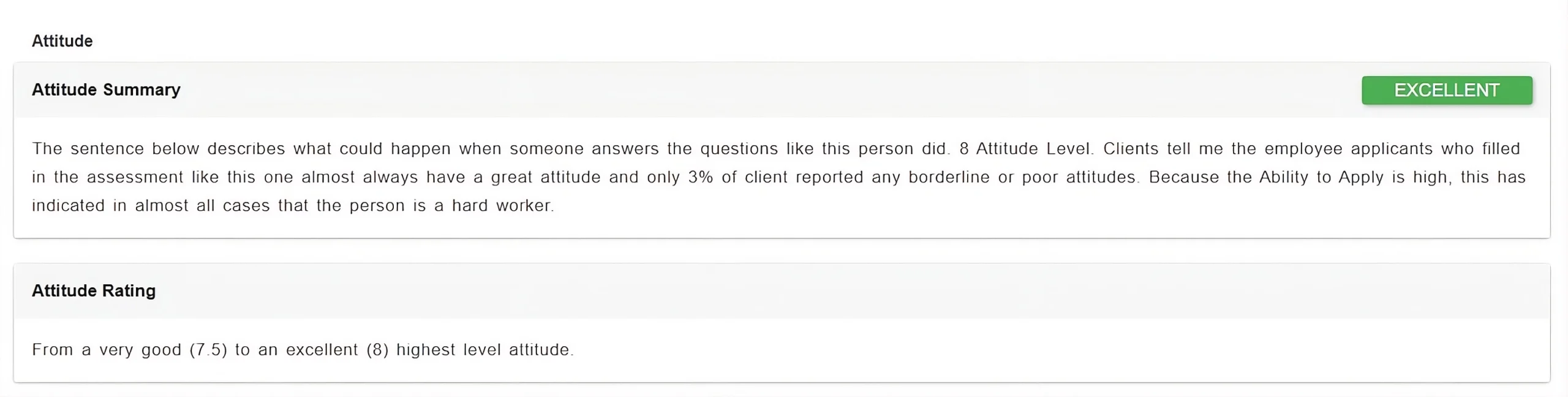
Attitude has nothing to do with a candidate's technical output. It describes how well they work with supervisors, how they fit into the team, and whether they contribute to or take away from the well-being of the company — patterns that are difficult to detect in a structured interview but become clearly visible in a validated behavioral assessment.
Why Integrity & Attitude Matters in Hiring
Skills and experience tell you what someone can do. However, Integrity & Attitude predicts how they'll actually behave once the pressure of daily work replaces the motivation to impress.

Management Time
Poor-attitude employees consume disproportionate manager time through feedback loops, conflict mediation, and documentation.

Team Morale
Negativity and blame spread fast. A single low-attitude hire can erode team engagement and output within weeks.

Real Business Cost
SHRM estimates a bad hire costs 50–60% of annual salary — before cultural damage, customer impact, or replacement costs.
How a low Integrity & Attitude score shows up on the job
These patterns are rarely visible in the interview — but typically become clear within the first few weeks on the job.
Learn more about our Assessments
"*" indicates required fields
The Five Integrity & Attitude Traits
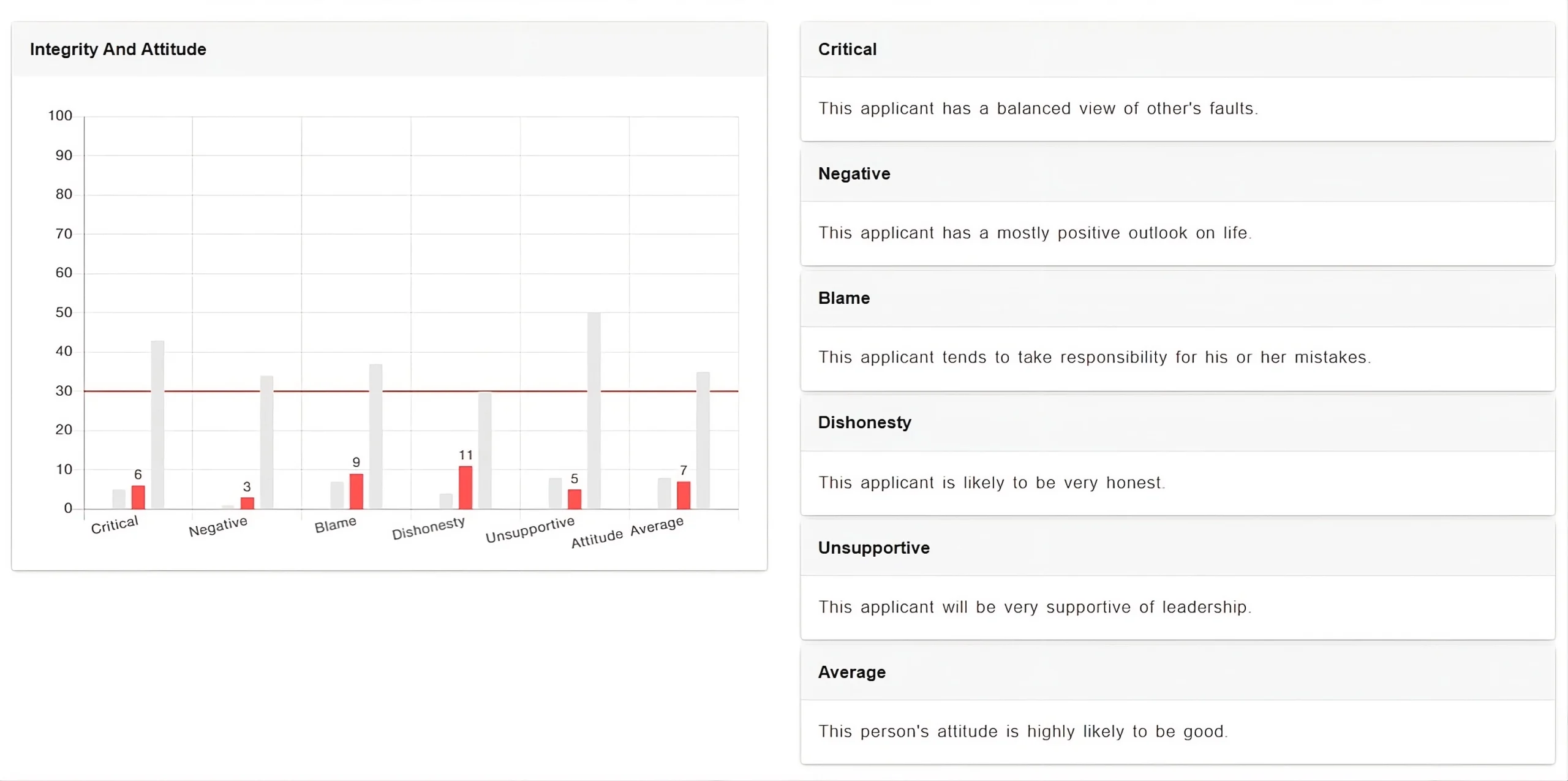
Each trait is scored independently and then combined into an overall Integrity & Attitude Average.
Because of this, reading the pattern across all five matters more than any single score.

Critical
Fault-finding, gossiping, and combativeness toward others. Scores above 37 signal a pattern worth exploring in follow-up.

Negativity
A persistent negative outlook even when conditions are good. Most significant when paired with elevated Critical or Blame scores.

Blame
Shifting responsibility for outcomes the candidate created or could have prevented. Scores above 54 predict blame-shifting behavior.

Dishonesty
Willingness to misrepresent facts when the truth feels risky. Scores above 25 predict falsification behavior.

Unsupportive
Personal agendas over company priorities — low loyalty and authority issues. High scores alongside Critical and Blame predict authority-resistant employees.
Integrity & Attitude Average
A composite of all five traits — the primary score for hiring decisions. Below 8 indicates a negative attitude pattern; above 10, a positive one. Always read it alongside individual scores: the average shows severity, the traits show type.

Best Practice: Don't make hiring decisions based on a single trait. The strongest signal comes from the overall Integrity & Attitude Average read alongside individual scores, Reliability Indicators, interview responses, and references.
attitude problems
18 months
Most Failed Hires Fail Because of Attitude — Not Skills
A LeadershipIQ study of 5,247 hiring managers across 312 organizations found the following behind those failures:
26%
| Couldn't accept feedback from managers |
23%
Core traits like openness, resilience, sociability
17%
Situational responses, conflict resolution, work style
15%
Integrity, accountability, enthusiasm
11%
Drive to excel, ambition, initiative
Source: LeadershipIQ — Why New Hires Fail · Study of 5,247 hiring managers across 312 organizations
How to Interpret Integrity & Attitude Results
Each report gives you a numeric score and a breakdown by trait.
Specifically, the Integrity & Attitude Average is the composite score from all five traits — the primary number used to guide hiring decisions.
Below 8
Negative attitude indicators
8 – 10
Borderline / neutral range
Above 10
Positive attitude indicators
Extreme ranges: −40 or below = extremely poor · +50 or above = extremely good
Integrity & Attitude Level Outcome Predictions
From a 2010 proprietary client research study. Percentages apply to job applicants.
Level
Predicted Outcomes
2
71% very poor · 29% poor
3
43% very poor · 29% good
4
24% very poor · 26% good · 38% borderline
6
75% good or very good
7.5
96% good or very good
The attitude level appears on the second line under Attitude in the Aptitude report.
Pairing a Behavioral with an Ability test improves prediction accuracy by approximately 30%.
What to Do Based on Your Results
All traits below threshold — continue the process and validate key strengths in the interview.
One trait slightly elevated — ask targeted behavioral questions about that specific pattern. Check references.
One or more traits significantly elevated — use the report's probe questions. Explore with references before deciding.
Two or more traits elevated simultaneously — treat as a serious signal, especially for trust-based or supervisory roles.

Assessment results support decisions — they don't make them. Always interpret scores in context: the specific role, interview performance, references, and your organization's culture. No single score should be a standalone disqualifier.
Which Assessments Evaluate Integrity & Attitude?
Each trait is scored independently and combined into an overall Integrity & Attitude Average.
Read the pattern across all five — a single elevated score means far less than two or three elevated together.

Individual Contributor (IC) Behavioral Assessment Test
All Integrity & Attitude traits plus Personality and People Traits. The most complete behavioral picture for individual contributors.
Best for: Administrative, operations, customer service, frontline, and support roles

Sales & Leadership (SL) Behavioral Assessment
Same Integrity & Attitude traits as the IC, plus sales and leadership-specific measures for roles where influence and decision-making under pressure matter most.
Best for: Sales, leadership, management, executive, and people-facing roles

IntegrityFirst Assessment
Fast overt integrity screen. Outputs a simple Qualified / Unqualified result — no trait breakdown.
Best for: Frontline, warehouse, retail, and safety-sensitive high-volume roles

Positivity & Integrity Assessment
Short early-stage screen for honesty, accountability, and workplace attitude. A quick first filter before committing time to interviews.
Best for: Early-stage screening, high-volume hiring, or when time is limited
Want to see a sample report?
Get a real example of what the IC or SL Behavioral report looks like — scores, trait breakdowns,
and interpretation guidance included.
Not sure which assessment fits? Our team can help you choose based on the role, hiring volume, and depth of evaluation you need. Book a free demo →
Integrity & Attitude Matters for Every Role You Hire
There's no position where attitude doesn't affect performance.
Whether you're hiring a frontline employee or a senior leader, the patterns this assessment measures show up the same way — they just cost more at higher levels.
Relevant for all role types

Customer Service & Frontline

Sales & Account Management

Operations & Logistics

Administrative & Support

Managers & Supervisors

Remote & Hybrid Teams

Technical & Specialized

Executive & Leadership
If any of these situations sound familiar, this assessment is for you
Frequently Asked Questions
Integrity & Attitude is one of three primary dimensions measured by the IC and SL Behavioral Assessments from Discovered Assessments, alongside Personality and People Traits. It has nothing to do with technical production abilities — instead, it predicts how well a candidate will get along with their supervisor, fit into the team, and contribute to the well-being of the company. A high percentage of employees who rate poorly on Integrity & Attitude end up quitting or being terminated. The assessment captures how their integrity and attitude will look after the honeymoon period is over.
Let Our Team Help You Find the Right Assessment
Tell us about the position, hiring volume, and what you need to evaluate — and we'll recommend the exact assessment that fits your process.
Learn more about our Assessments
"*" indicates required fields