
The Patience Trait Measures Tolerance for Delay Before You Hire
The patience trait is one of four dimensions in the Supporter and Empathy quadrant of the Behavioral Assessments. It tells you who stays composed while a colleague or a machine holds up the work, and who pushes to finish it regardless.

What Does the Patience Trait Measure?
The patience trait measures the tolerance a person feels when experiencing other people's inactivity, slowness or delay, or when slow equipment gets in the way. In other words, it measures how much inner calm somebody keeps while others or things prevent them from taking immediate action.
What the patience trait is not
The assessment states it plainly: this is not a description of apathy. A tolerant candidate still wants the result. Furthermore, the Wimbush Aptitude Assessment leaves the trait out entirely, because it relies on Empathy and Listening to determine personality type instead.
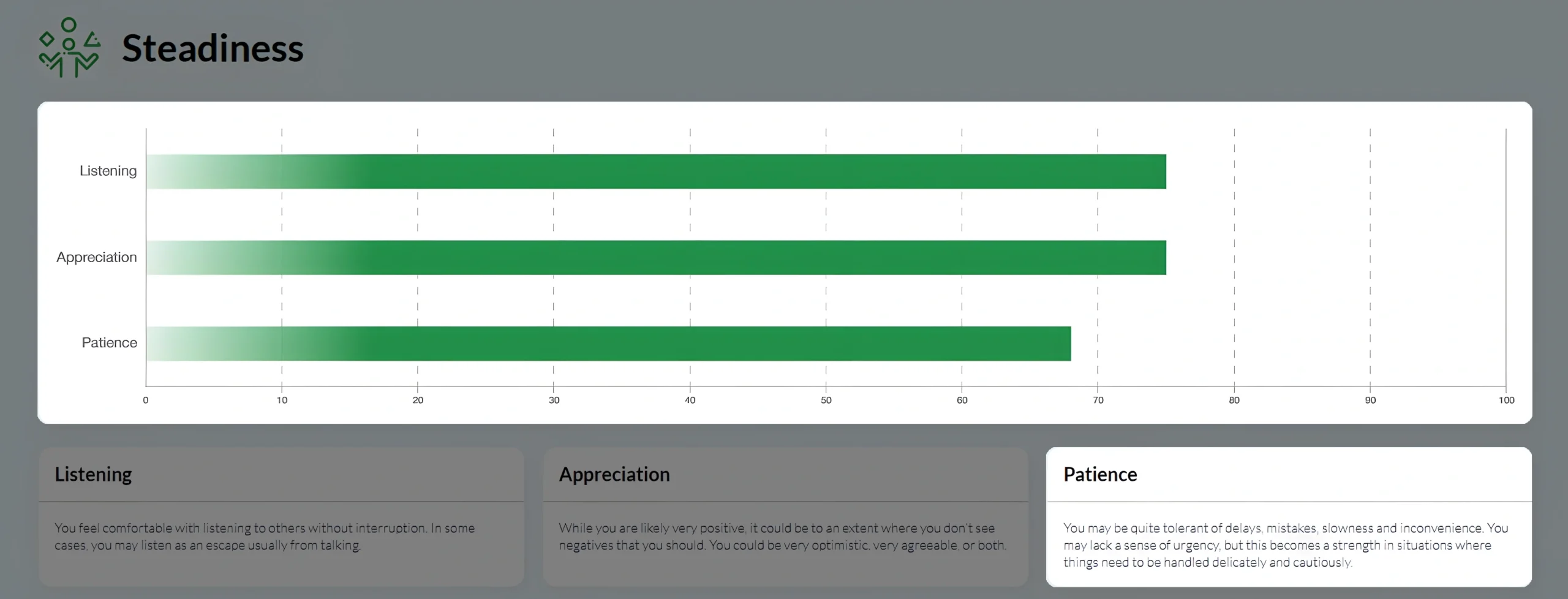
What the Patience trait helps you evaluate before you hire

Medium is the only reading the assessment clears everywhere. From 40 to 60 the trait would not adversely affect any position, which makes the middle band a safe default whenever a role mixes service work with deadlines.
Why the Patience Trait Matters in Hiring
Calm is not automatically the better answer here. The reading that makes a patient teacher is the same one the assessment rates poor for leaders, managers and salespeople, so the position decides which direction you want.

Impatience Costs Thoroughness
Low scorers focus hard on getting things done, and the assessment warns that the very same drive pushes them toward doing a less than thorough job.

Tolerance Costs Urgency
High scorers stay tolerant of delays and inconvenience, though they lack a sense of urgency. The assessment calls this range poor for leaders, managers and salespeople.

Patience Is Not Apathy
The assessment separates the two directly. A patient candidate still wants the result, and keeps inner calm while other people or slow equipment delay the work.

How a mismatched Patience score shows up on the job
The reading stays invisible until somebody or something slows the work down. Consequently, each end of the scale damages a different part of the operation.
Learn more about our Assessments
"*" indicates required fields
How the Patience Trait Is Scored
The patience trait is scored from 0 to 100, and the three bands below summarize the picture. Because service work and commercial work reward opposite readings, your benchmark for the position decides what a strong score looks like.

Medium is the only band the assessment clears everywhere — from 40 to 60 it would not adversely affect any position.
Low — 0 to 39
A high level of urgency, and below 5 the frustration with slow people and equipment turns severe. The assessment recommends this range for managers, leaders and salespeople.
Medium — 40 to 60
Shows a good balance of tolerance for slowness against urgency in getting something done. The assessment states directly that this range would not adversely affect any position.
High — 61 to 100
Quite tolerant of delays and inconvenience, and above 96 that tolerance becomes total. The sense of urgency disappears, so the assessment firmly recommends teaching, nursing and customer service.
Patience is one of four traits measured together in the Supporter and Empathy quadrant
Each trait in this quadrant shapes how candidates treat other people, and moreover two readings outside it carry an explicit warning in the assessment.

Impulsive
The assessment relates high patience to low impulsiveness. Impulsive scores the speed of decisions, so read both whenever the position rewards acting quickly under real pressure.

Competitive
Competitive scores the drive to win. The assessment relates high patience to low competitiveness, and that same low score feeds the manager warning noted under Assertiveness.

Assertiveness
A high patience score with low Assertiveness and low Competitiveness carries a warning: these people will not make good managers, and they will not close sales.

Reliable
The assessment relates high patience somewhat to unreliability. Read Reliable alongside this score before assuming that a very tolerant candidate will still deliver work on schedule.

Ability to Apply
The assessment relates high patience to low ability to apply, which it labels lazy. Check that tolerance for delay does not mask low energy for work.
Supporter / Empathy Quadrant
This quadrant pairs the reading with Empathy, Appreciation and Listening, describing an interest in pleasing and comforting others. It sits opposite the Controller and Assertive quadrant.

Best Practice: Assessment results support your hiring decisions, they do not replace them. Always read the patience trait score alongside the full profile and your role benchmarks before drawing a conclusion.
How to Interpret Patience Results
Interpretation depends on what the position actually asks of the person. Both Behavioral Assessment versions report this trait, and Work Styles DISCovered reports it as well.
What to Do Based on Your Patience Score
Urgency at this level suits fast-moving commercial work. Watch thoroughness, because the assessment warns that impatience drives these people toward a less than thorough job.
A recommended reading for managers, leaders and salespeople. Keep this candidate away from teaching, nursing, social work and customer service, where the assessment rates them horrible.
The safest band on this trait, since the assessment states it would not adversely affect any position. Move on and compare the rest of the quadrant.
Strong for teaching, nursing and customer service. Before promoting into management or sales, check Assertiveness and Competitiveness, because the assessment attaches a warning to that combination.
Outstanding wherever repetition and patience carry the work. Expect no sense of urgency at all, though the assessment confirms this reading indicates no attitude problem whatsoever.
Assessment results support decisions, they do not make them. Always interpret scores in context: the specific role, interview performance, references, and your organization's culture.
The Patience Trait Matters for Every Role You Hire
Because a strong score helps in one position and hurts in another, benchmarks define what each reading means. Therefore, review results against the benchmark for the specific job.
Roles where Patience is especially critical
| Role | Why it matters |
|---|---|
| Teaching and Training | The assessment recommends the high range for teachers, since these people stay tolerant of slowness and repetition. Low scorers rate as horrible in the same positions. |
| Customer Service | Service work runs on tolerance for delay, confusion and repeated questions. The assessment places nurses, social workers and customer service people firmly in the upper ranges. |
| Management and Leadership | Managers need urgency, so the assessment recommends the lower ranges. Above 61 the sense of urgency disappears, and the warning about managers and sales closers applies. |
| Sales Roles | Selling rewards a low reading, because urgency pushes the close. The assessment names salespeople among the roles where a high patience score works directly against performance. |
Relevant for all role types

Customer Service Rep

Sales Manager

Trainer or Instructor

Account Executive

Registered Nurse

Operations Manager
Technical Support Rep

Project Manager
If any of these situations sound familiar, this assessment is for you
Want to see a sample report?
Get a real example of what the IC or SL Behavioral report looks like — scores, trait breakdowns,
and interpretation guidance included.
Not sure which assessment fits? Our team can help you choose based on the role, hiring volume, and depth of evaluation you need. Book a free demo →
Frequently Asked Questions
The patience trait measures the tolerance a person feels when experiencing other people's inactivity, slowness or delay, or when slow equipment holds things up. In short, it measures how much inner calm somebody keeps while others prevent them from taking immediate action.
Let Our Team Help You Find the Right Assessment
Tell us which positions you are filling, and we will match the right assessment to them and configure the benchmarks your team should be scoring against.
Learn more about our Assessments
"*" indicates required fields