
Customer Service Strength Trait Measures Handling Upset Customers Before You Hire
The customer service strength trait is one of the People Traits scored on the Aptitude assessments. It predicts what happens after something goes wrong, at the exact point where a hire either saves the account or loses it.

What Does the Customer Service Strength Trait Measure?
The customer service strength trait measures the knowledge, and most likely the ability, to effectively work with people who are frustrated with a company or with a company service or product. In other words, it scores what somebody does once a customer is already unhappy.
What the customer service strength trait is not
It does not measure the ability to supervise other people, which the assessment scores separately. The questions target an individual contributor position that works with customers verbally, so a strong reading here says nothing about running a team.
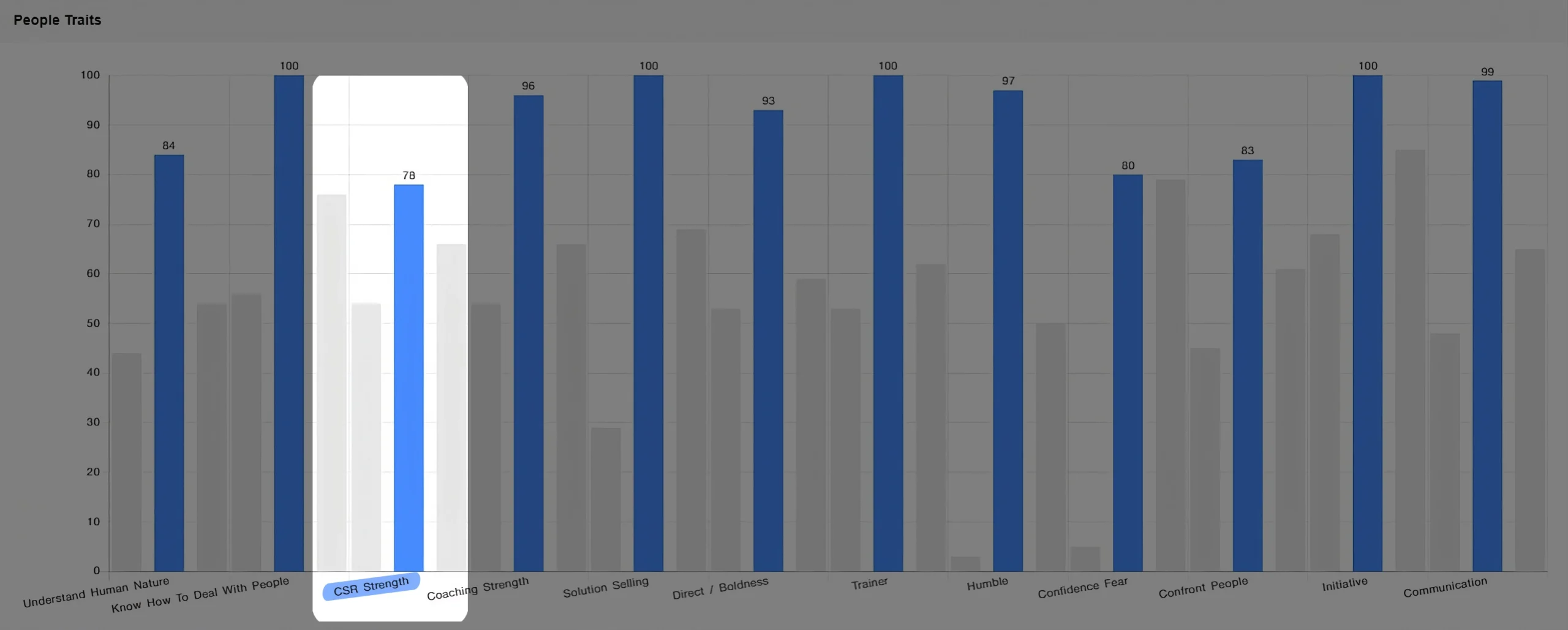
What the Customer Service Strength Trait Helps You Evaluate Before You Hire

The assessment calls this the caregiver side of customer service. It scores fourteen questions, each offering five answers with only one correct, so a candidate could reach 20 by guessing alone. Treat anything under 25 as no demonstrated knowledge.
Why the Customer Service Strength Trait Matters in Hiring
This trait scores knowledge of a single moment: the one after a customer is already unhappy. Because ordinary interactions reveal nothing about it, the reading predicts exactly the conversations an interview never simulates.

Knowledge Plus Likely Ability
Every range is phrased as knowledge and most likely ability, so a strong reading predicts performance rather than only awareness.

Six Ranges, Not Five
An extra band separates poor from borderline here, so read the exact number rather than the label on its own.

Not a Supervision Signal
The assessment states plainly that this does not measure the ability to supervise, so it never justifies a promotion decision.

How a low Customer Service Strength score shows up on the job
The gap only appears once a customer is already upset. Consequently, ordinary interactions look fine while the difficult ones cost you the relationship.
Learn more about our Assessments
"*" indicates required fields
How the Customer Service Strength Trait Is Scored
The score runs from 0 to 100, and the three bands below summarize it. Because complaint volume differs sharply between positions, benchmark the number against the specific seat.
Low — under 46
Poor to borderline understanding of handling a frustrated customer. The assessment grades 26 to 37 poor, 38 to 45 borderline.
Medium — 46 to 56
An OK understanding, and most likely an OK ability, to handle a customer already frustrated with your company or service.
High — 57 to 100
A good understanding and likely ability, which the assessment upgrades to very good above 75 on both of those counts.

This trait uses six named ranges rather than the usual five. The assessment splits Poor from Borderline below the OK band, so a candidate at 30 and a candidate at 42 read differently even though both sit under the same summary band.
Customer Service Strength is one of the People Traits on the Aptitude assessments
Three other readings in this set name this one among their own close relations, and consequently it turns up in more places than its own list suggests.

Understand Human Nature
The assessment names it closely related. Reading why a customer is angry comes first, and this trait covers what follows.

Know How to Deal with People
The assessment names it closely related. That trait covers influencing anybody, while this one narrows it to somebody already frustrated.

Coaching Strength
Coaching Strength names this trait closely related. Coaching develops a colleague over time, while service recovery gets one single conversation.

Trainer
Trainer names this trait closely related. Explaining a procedure and defusing a complaint draw on knowledge that does not overlap.

Relationship Sales
Relationship Sales names this trait closely related. Keeping a customer buying depends on what happens the day something goes wrong.
People Traits
The category this trait belongs to, where scored questions test knowledge about people instead of asking them for self-description.

Best Practice: Never treat this score as a supervision signal. The assessment states plainly that it does not measure the ability to supervise other people, so check Supervisor Strength separately before promoting anybody.
How to Interpret Customer Service Strength Results
Six named ranges cover this trait rather than the usual five. Both the IC Aptitude Test and the Sales Aptitude Test include it, so benchmark against the version the candidate took.
What to Do Based on Your Results
Guessing alone could reach 20 here, so treat this as no demonstrated knowledge. The assessment calls the understanding and ability to handle frustrated customers very poor.
A poor understanding, and most likely a poor ability, to handle frustrated customers. Keep this candidate well away from any position that fields customer complaints directly.
A borderline understanding, and most likely a borderline ability. Workable only where escalations reach somebody else quickly, and never where this person is the last line.
An OK understanding, and most likely an OK ability, to handle frustrated customers. Compare it against your role benchmark, since service volume differs sharply between positions.
A good understanding, and most likely a good ability, to handle people frustrated with your company. Strong for any seat that takes complaints as routine work.
A very good understanding and very good likely ability. Place this candidate where recovery matters most, though remember the assessment says nothing about supervising other people.
Assessment results support your hiring decisions, they do not replace them. Always read the customer service strength score alongside the full profile and your role benchmarks before drawing a conclusion.
The Customer Service Strength Trait Matters for Every Role You Hire
Because complaint exposure differs sharply between positions, benchmarks define what each reading means. Therefore, review results against the benchmark for the specific job.
Roles where Customer Service Strength is especially critical
| Role | Why it matters |
|---|---|
| Frontline Service | The fourteen questions were built around a customer service position, so no other reading aims at that seat as directly. |
| Technical Support | A correct fix delivered badly still loses the customer. Read this beside the technical scores whenever one person does both. |
| Account and Client Success | Relationship Sales names this closely related, because keeping a customer depends on how the first serious problem actually gets handled. |
| Not for Supervision | Check Supervisor Strength separately before promoting your strongest service representative, because this reading says nothing whatsoever about supervising other people. |
Relevant for all role types
Customer Service Rep

Account Manager

Technical Support Rep

Field Service Technician

Client Success Manager

Call Center Agent

Front Desk Coordinator

Retail Associate
If any of these situations sound familiar, this assessment is for you
Want to see a sample report?
Get a real example of what the Sample IC Ability report looks like — scores, trait breakdowns,
and interpretation guidance included.
Not sure which assessment fits? Our team can help you choose based on the role, hiring volume, and depth of evaluation you need. Book a free demo →
Frequently Asked Questions
The customer service strength trait measures the knowledge, and most likely the ability, to effectively work with people who are frustrated with a company or with a company service or product. In short, it scores what somebody does once a customer is already unhappy.
Let Our Team Help You Find the Right Assessment
Tell us which positions you are filling, and we will match the right assessment to them and configure the benchmarks your team should be scoring against.
Learn more about our Assessments
"*" indicates required fields