
Identify Persistent Negativity Attitude Before It Drags Your Team Down
The Negativity trait is one of five dimensions in the Integrity & Attitude section of our Behavioral Assessments. A negativity attitude assessment measures a tendency to see conditions as worse than they are, a pattern that spreads to the team and is difficult to detect in interviews.

What Does a Negativity Attitude Assessment Measure?
The Negativity trait measures "a belief that things, conditions, or one's own abilities are worse than they really are".
It is part of the Integrity & Attitude section of our Behavioral Assessments. It does not measure realistic concern or constructive criticism. It measures a persistent tendency to interpret neutral or positive conditions as negative ones.
Why a negativity attitude assessment captures what interviews miss
A candidate with an elevated Negativity score may present as cautious or detail-oriented in a short interview. However, a negativity attitude assessment measures this pattern across multiple questions, where it is far harder to maintain a consistently positive response.
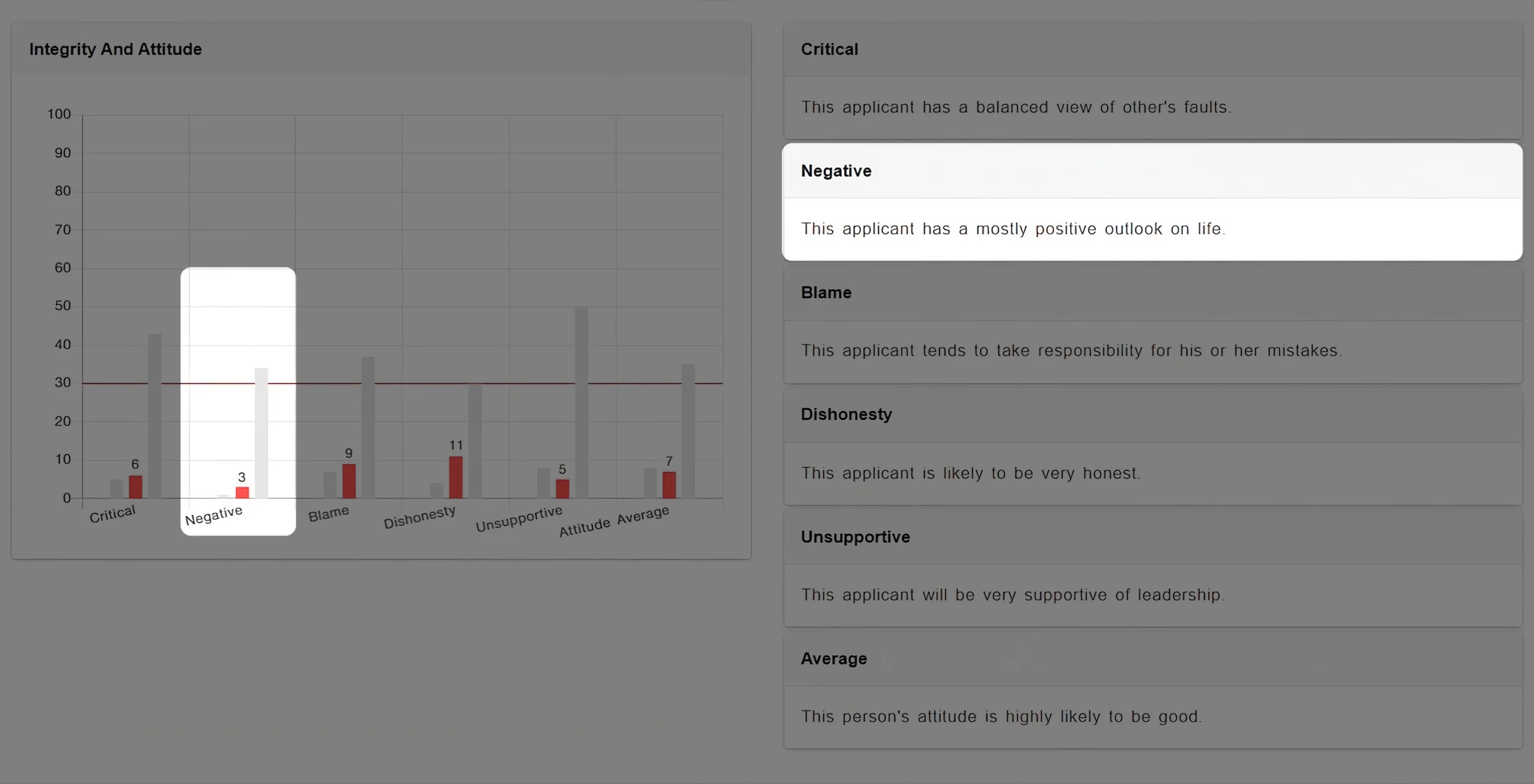
What the Negativity trait helps you evaluate before you hire

Negativity is not the same as being realistic or direct. Someone who identifies genuine risks and communicates them constructively scores differently than someone with a persistent pattern of seeing conditions as worse than they are. The assessment measures outlook pattern, not analytical ability.
Why Measuring Workplace Negativity Matters in Hiring
An elevated Negativity score affects the people around that person, not just their own outlook. Pessimism is one of the most contagious behavioral patterns in a team environment. It is also one of the hardest to address directly because it rarely produces a single documentable incident.

Team Morale
Persistent negativity spreads quietly. One consistently pessimistic team member can lower the energy and engagement of those around them within weeks, often before any manager identifies the source of the shift.

Management Attention
Employees with an elevated Negativity score require more reassurance and context to maintain basic engagement. As a result, managers spend time counteracting pessimism instead of focusing on forward progress.

Customer and Client Exposure
In customer-facing roles, a negative outlook does not stay internal. Customers and clients pick up on tone quickly, and a persistently pessimistic employee directly affects how the organization is perceived.

How elevated Negativity scores show up on the job
These patterns are rarely visible in the interview. They typically become clear within the first few weeks once the candidate settles into the role.
Learn more about our Assessments
"*" indicates required fields
How the Negativity Attitude Trait Is Scored
The Negativity trait is measured across six questions in our Behavioral Assessments.
Because it is the smallest trait in the Integrity & Attitude section, a high or low reading may not be significant on its own. Its weight depends primarily on the overall I&A Average.
Unlike other I&A traits, Negativity does not have a single fixed score threshold. Its significance depends on the I&A Average and whether other traits are also elevated. Always read it in context.
Within range
Low individual concern
Elevated
Note and read in context of I&A Average
Extremely high
Follow-up recommended regardless of other scores
Negativity is one of five traits measured together
Behavioral Assessments score all five Integrity & Attitude traits together: Critical, Blame, Dishonesty, Negativity, and Unsupportive. The I&A Average combines them into a single composite indicator. Below is how Negativity interacts with each when both are elevated.

Critical
A persistent pessimistic outlook combined with fault-finding directly amplifies morale damage. This is the most common and most impactful Negativity combination in team environments.

Blame
Negativity combined with blame-shifting creates a pattern where the candidate sees conditions as bad and holds others responsible. This combination predicts recurring conflict and low accountability.

Dishonesty
Less common as a combination. However, when present, a negative outlook alongside dishonesty creates situations that are difficult to document and address, particularly in high-trust roles.

Unsupportive
Personal agendas over company priorities — low loyalty and authority issues. High scores alongside Critical and Blame predict authority-resistant employees.
Integrity & Attitude Average
A composite of all five traits — the primary score for hiring decisions. Below 8 indicates a negative attitude pattern; above 10, a positive one. Always read it alongside individual scores: the average shows severity, the traits show type.

Best Practice: Do not make hiring decisions based on the Negativity score alone. The strongest signal comes from the I&A Average read alongside all five individual scores, Reliability Indicators, interview responses, and reference checks.
How to Interpret Negativity Attitude Assessment Results
Your negativity attitude assessment results should always be read in context of the full I&A profile.
Because Negativity is measured across only six questions, the I&A Average carries more weight. Negativity's role is to help explain what kind of attitude pattern is present.
What to Do Based on Your Negativity Score
Score within normal range. Continue the hiring process. Validate the I&A Average alongside individual scores. Negativity alone is unlikely to be the primary concern.
Score is elevated. Read alongside the I&A Average and the other four traits. If Critical or Blame is also elevated, treat the combination as a meaningful signal and ask one or two follow-up questions about how the candidate approaches setbacks.
Score is extremely high. Follow-up is recommended even if other traits are within range. Contact previous supervisors to validate the general outlook. The Discovered Assessments manual specifically notes this case as worth exploring regardless of the overall average.
The Negativity Trait Matters for Every Role You Hire
Negativity creates friction in any role.
The impact is highest in team-facing, customer-facing, and leadership positions — where one person's outlook directly shapes how others feel about their work.
Relevant for all role types

Customer Service & Frontline

Sales & Account Management

Operations & Logistics

Administrative & Support

Managers & Supervisors

Remote & Hybrid Teams

Technical & Specialized

Executive & Leadership
If any of these situations sound familiar, this assessment is for you
Want to see a sample report?
Get a real example of what the IC or SL Behavioral report looks like — scores, trait breakdowns,
and interpretation guidance included.
Not sure which assessment fits? Our team can help you choose based on the role, hiring volume, and depth of evaluation you need. Book a free demo →
Frequently Asked Questions
A negativity attitude assessment measures a candidate's tendency to perceive conditions, situations, and their own abilities as worse than they actually are. In our Behavioral Assessments, this is scored through the Negativity trait, one of five dimensions within the Integrity & Attitude section. It does not measure realistic concern. Instead, it measures a persistent outlook pattern that affects how the candidate relates to the team and the work environment.
Let Our Team Help You Find the Right Assessment
Tell us about the position and what you need to evaluate. Our team will recommend the exact assessment that fits.
Learn more about our Assessments
"*" indicates required fields